THOMPSON INTRODUCES FEDERALISM ACCOUNTABILITY ACT
Bill Will Protect Authority of State and Local Governments
Washington, DC -- Senate Governmental Affairs Committee Chairman Fred Thompson (R-TN) introduced legislation late yesterday to protect state and local governments from unchecked federal intrusion. The “Federalism Accountability Act” would impose accountability on Congress and the Executive Branch before they could override state and local law.
“The Founding Fathers divided power between the federal government and the states. The constitutional principle of federalism -- embodied in the Tenth Amendment -- raises two fundamental questions that policy makers should answer: What should government be doing? And what level of government should do it? Everything else flows from them. That’s why federalism is at the heart of our democracy,” said Senator Thompson.
“Our governmental structure is based on an optimistic belief in the power of people and their communities,” added Thompson. “I share that view.”
A recent General Accounting Office report shows that there has been gross noncompliance with a 1987 executive order directing federal agencies to prepare federalism assessments for actions that would preempt state and local laws. In a review of over 11,000 issued over a 3-year period, GAO found that the agencies had prepared only five federalism assessments under the executive order.
“Congress and the Administration should not take lightly the preemption of state and local laws,” Thompson said. “We need to face the fact that Congress too often has acted as if it has a general police power to engage in any issue, no matter how local. Both Congress and the Executive Branch have neglected to consider prudential and constitutional limits on their powers.”
The Federalism Accountability Act would:
require Congress and agencies to issue an explicit statement of congressional or agency intent when they preempt state or local law, and if so, an explanation of the reasons for such preemption;
require each agency head to designate a federalism officer to implement the requirements of this legislation and to serve as a liaison to state and local officials;
require agencies early on to notify, consult with, and provide an opportunity for meaningful participation by state and local public officials that could potentially be affected by a rule;
require agencies to provide a federalism assessment for rules that have federalism impacts;
require the Congressional Budget Office to compile a report on preemptions by federal rules, court decisions, and legislation;
amend the Government Performance and Results Act of 1993 to clarify that performance measures for state-administered grant programs are to be determined in cooperation with public officials;
and amend the Unfunded Mandates Reform Act of 1995 to clarify that major new requirements imposed on states under entitlement authority are to be scored by CBO as unfunded mandates. It also would require that when Congress caps the federal share of an entitlement program, the Committee report and the accompanying CBO report must analyze whether the legislation includes new flexibility or whether there is existing flexibility to offset additional costs.
This legislation was developed with representatives of the “Big 7" organizations representing State and local government, including the National Governors' Association, the National Conference of State Legislatures, the Council of State Governments, the National League of Cities, the National Association of Counties, the U.S. Conference of Mayors, and the International City/County Management Association.
Cosponsors include Senators Carl Levin (D-MI), George Voinovich (R-OH), Chuck Robb (D-VA), Thad Cochran (R-MS), Blanche Lincoln (D-AR), Bill Roth (R-DE), John Breaux (D-LA), Mike Enzi (R-WY) and Evan Bayh (D-IN).
http://hsgac.senate.gov/061199_press.htm
Monday, April 23, 2007

Passage of Thompson Regulatory Right-to-Know Legislation
Senators Thompson, Stevens, and Breaux Announce Final Passage of Regulatory Right-to-Know Legislation
WASHINGTON - Senate Governmental Affairs Committee Chairman Fred Thompson (R-TN), Senate Appropriations Committee Chairman Ted Stevens, (R-AK), and Senator John Breaux (D-LA) announced that the Senate yesterday approved the Thompson-Stevens-Breaux Regulatory Right-to-Know Act. The Act will require the White House’s Office of Management and Budget (OMB) to disclose to the public the costs and benefits of regulatory programs in a report to be included each year in the Federal Budget. The legislation is contained in Section 624 of the Treasury-Postal Appropriations conference report, which now goes to the President for his signature.
"The Regulatory Right-to-Know Act is based on a simple but important idea," Chairman Thompson said. "People have a right to know the costs and benefits of important regulatory decisions. This will help the Congress, the President, and the public better understand whether regulations are sensible and fair."
Senator Stevens, chairman of the Senate Appropriations Committee, said, "This is an important tool for decision-makers. It will give Congress the ability to perform its oversight function in a more efficient and effective manner. In order to make sound decisions, Congress must have access to how and why agencies make decisions, and what the consequences of those decisions would be."
"Government has an obligation to carefully consider mandates that impose costs on people and limit their freedom," Senator Breaux said. "Now we members of Congress and the American people will know, each year, the real value of proposed Federal regulations."
The Thompson-Stevens-Breaux legislation, which has been included in the Treasury-Postal Appropriations bill as a one-year reporting requirement for the last two years, strengthens and makes permanent the original regulatory accounting provision secured by Senator Ted Stevens (R-AK) in 1996. The Regulatory Right-to-Know Act requires the OMB director to provide Congress with a report on the total annual benefits and costs of Federal regulatory programs, as well as an analysis of the impacts of federal regulation on State, local, and tribal government, small business, wages, and economic growth. It also requires OMB to issue agency guidelines and to solicit public comment and expert peer review to continually improve the quality of the reports.
"This is about good government," Thompson said. "This legislation will help hold Federal agencies accountable for the cost and effectiveness of their regulations and reduce needless waste and red tape. It will promote responsible efforts to protect public health, safety and the environment, and it will promote the economic security and well-being of our families and communities. I am pleased that the costs and benefits of regulation can now receive the attention of the Executive Branch and Congress when we debate the Federal Budget each year."
http://hsgac.senate.gov/101300c_press.htm
WASHINGTON - Senate Governmental Affairs Committee Chairman Fred Thompson (R-TN), Senate Appropriations Committee Chairman Ted Stevens, (R-AK), and Senator John Breaux (D-LA) announced that the Senate yesterday approved the Thompson-Stevens-Breaux Regulatory Right-to-Know Act. The Act will require the White House’s Office of Management and Budget (OMB) to disclose to the public the costs and benefits of regulatory programs in a report to be included each year in the Federal Budget. The legislation is contained in Section 624 of the Treasury-Postal Appropriations conference report, which now goes to the President for his signature.
"The Regulatory Right-to-Know Act is based on a simple but important idea," Chairman Thompson said. "People have a right to know the costs and benefits of important regulatory decisions. This will help the Congress, the President, and the public better understand whether regulations are sensible and fair."
Senator Stevens, chairman of the Senate Appropriations Committee, said, "This is an important tool for decision-makers. It will give Congress the ability to perform its oversight function in a more efficient and effective manner. In order to make sound decisions, Congress must have access to how and why agencies make decisions, and what the consequences of those decisions would be."
"Government has an obligation to carefully consider mandates that impose costs on people and limit their freedom," Senator Breaux said. "Now we members of Congress and the American people will know, each year, the real value of proposed Federal regulations."
The Thompson-Stevens-Breaux legislation, which has been included in the Treasury-Postal Appropriations bill as a one-year reporting requirement for the last two years, strengthens and makes permanent the original regulatory accounting provision secured by Senator Ted Stevens (R-AK) in 1996. The Regulatory Right-to-Know Act requires the OMB director to provide Congress with a report on the total annual benefits and costs of Federal regulatory programs, as well as an analysis of the impacts of federal regulation on State, local, and tribal government, small business, wages, and economic growth. It also requires OMB to issue agency guidelines and to solicit public comment and expert peer review to continually improve the quality of the reports.
"This is about good government," Thompson said. "This legislation will help hold Federal agencies accountable for the cost and effectiveness of their regulations and reduce needless waste and red tape. It will promote responsible efforts to protect public health, safety and the environment, and it will promote the economic security and well-being of our families and communities. I am pleased that the costs and benefits of regulation can now receive the attention of the Executive Branch and Congress when we debate the Federal Budget each year."
http://hsgac.senate.gov/101300c_press.htm
Thompson Measure Increases Govt Access to Commercial Markets
THOMPSON MEASURE INCREASES GOVERNMENT ACCESSTO COMMERCIAL MARKETS
(Washington, DC) -- Governmental Affairs Committee Chairman Fred Thompson yesterday introduced legislation to revise accounting standards used for Federal government contracts (S. 1151). In addition, Senator Thompson was successful in getting the bill language included as an amendment to the Fiscal Year 2000 National Defense Authorization Act approved last night by the Senate.
Senator Thompson said, "Industry sellers and government buyers continue to identify the government’s Cost Accounting Standards as a remaining barrier to the integration of commercial items into the government marketplace. This bill carefully balances the government’s need for greater access to commercial items, particularly those of nontraditional suppliers, with the need for strong accounting standards to protect taxpayer dollars."
Joining Senator Thompson in this effort are Governmental Affairs Committee Ranking Member Joseph Lieberman (D-CT), and the Chairman and Ranking Member of the Armed Services Committee, Senators John Warner (R-VA) and Carl Levin (D-MI).
In recent years, Congress has enacted two major acquisition reform statutes which changed the trend in government contracting toward simplifying the government’s acquisition process and eliminating many government-unique requirements. In keeping with this trend toward commercial market practices, this bill further streamlines the federal procurement system to save taxpayer dollars.
Senator Thompson’s bill would:
· raise the threshold for coverage under the Cost Accounting Standards from $25 million to $50 million;
· exempt contractors from coverage if they do not have a contract in excess of $5 million;
· exclude coverage based on firm, fixed price contracts awarded on the basis of adequate price competition without the submission of certified cost or pricing data; and
· provide for waivers by agencies under certain situations.
http://hsgac.senate.gov/052899_press.htm
(Washington, DC) -- Governmental Affairs Committee Chairman Fred Thompson yesterday introduced legislation to revise accounting standards used for Federal government contracts (S. 1151). In addition, Senator Thompson was successful in getting the bill language included as an amendment to the Fiscal Year 2000 National Defense Authorization Act approved last night by the Senate.
Senator Thompson said, "Industry sellers and government buyers continue to identify the government’s Cost Accounting Standards as a remaining barrier to the integration of commercial items into the government marketplace. This bill carefully balances the government’s need for greater access to commercial items, particularly those of nontraditional suppliers, with the need for strong accounting standards to protect taxpayer dollars."
Joining Senator Thompson in this effort are Governmental Affairs Committee Ranking Member Joseph Lieberman (D-CT), and the Chairman and Ranking Member of the Armed Services Committee, Senators John Warner (R-VA) and Carl Levin (D-MI).
In recent years, Congress has enacted two major acquisition reform statutes which changed the trend in government contracting toward simplifying the government’s acquisition process and eliminating many government-unique requirements. In keeping with this trend toward commercial market practices, this bill further streamlines the federal procurement system to save taxpayer dollars.
Senator Thompson’s bill would:
· raise the threshold for coverage under the Cost Accounting Standards from $25 million to $50 million;
· exempt contractors from coverage if they do not have a contract in excess of $5 million;
· exclude coverage based on firm, fixed price contracts awarded on the basis of adequate price competition without the submission of certified cost or pricing data; and
· provide for waivers by agencies under certain situations.
http://hsgac.senate.gov/052899_press.htm
Signs of Intelligence?
From The Fred Thompson Report:
April 19, 2007
Signs of Intelligence?
One of the things that's got to be going through a lot of peoples' minds now is how one man with two handguns, that he had to reload time and time again, could go from classroom to classroom on the Virginia Tech campus without being stopped. Much of the answer can be found in policies put in place by the university itself.
Virginia, like 39 other states, allows citizens with training and legal permits to carry concealed weapons. That means that Virginians regularly sit in movie theaters and eat in restaurants among armed citizens. They walk, joke and rub shoulders everyday with people who responsibly carry firearms -- and are far safer than they would be in San Francisco, Oakland, Detroit, Chicago, New York City, or Washington, D.C., where such permits are difficult or impossible to obtain.
The statistics are clear. Communities that recognize and grant Second Amendment rights to responsible adults have a significantly lower incidence of violent crime than those that do not. More to the point, incarcerated criminals tell criminologists that they consider local gun laws when they decide what sort of crime they will commit, and where they will do so.
Still, there are a lot of people who are just offended by the notion that people can carry guns around. They view everybody, or at least many of us, as potential murderers prevented only by the lack of a convenient weapon. Virginia Tech administrators overrode Virginia state law and threatened to expel or fire anybody who brings a weapon onto campus.
successfully prevented a number of attempted mass murders. Evidence from Israel, where many teachers have weapons and have stopped serious terror attacks, has been documented. Supporting, though contrary, evidence from Great Britain, where strict gun controls have led to violent crime rates far higher than ours, is also common knowledge.
So Virginians asked their legislators to change the university's "concealed carry" policy to exempt people 21 years of age or older who have passed background checks and taken training classes. The university, however, lobbied against that bill, and a top administrator subsequently praised the legislature for blocking the measure.
The logic behind this attitude baffles me, but I suspect it has to do with a basic difference in worldviews. Some people think that power should exist only at the top, and everybody else should rely on "the authorities" for protection.
Despite such attitudes, average Americans have always made up the front line against crime. Through programs like Neighborhood Watch and Amber Alert, we are stopping and catching criminals daily. Normal people tackled "shoe bomber" Richard Reid as he was trying to blow up an airliner. It was a truck driver who found the D.C. snipers. Statistics from the Centers for Disease Control and Prevention show that civilians use firearms to prevent at least a half million crimes annually.
When people capable of performing acts of heroism are discouraged or denied the opportunity, our society is all the poorer. And from the selfless examples of the passengers on Flight 93 on 9/11 to Virginia Tech professor Liviu Librescu, a Holocaust survivor who sacrificed himself to save his students earlier this week, we know what extraordinary acts of heroism ordinary citizens are capable of.
Many other universities have been swayed by an anti-gun, anti-self defense ideology. I respect their right to hold those views, but I challenge their decision to deny Americans the right to protect themselves on their campuses -- and then proudly advertise that fact to any and all.
Whenever I've seen one of those "Gun-free Zone" signs, especially outside of a school filled with our youngest and most vulnerable citizens, I've always wondered exactly who these signs are directed at. Obviously, they don't mean much to the sort of man who murdered 32 people just a few days ago.
From: The Fred Thompson Report
http://abcradio.com/article.asp?id=389928&SPID=15663
April 19, 2007
Signs of Intelligence?
One of the things that's got to be going through a lot of peoples' minds now is how one man with two handguns, that he had to reload time and time again, could go from classroom to classroom on the Virginia Tech campus without being stopped. Much of the answer can be found in policies put in place by the university itself.
Virginia, like 39 other states, allows citizens with training and legal permits to carry concealed weapons. That means that Virginians regularly sit in movie theaters and eat in restaurants among armed citizens. They walk, joke and rub shoulders everyday with people who responsibly carry firearms -- and are far safer than they would be in San Francisco, Oakland, Detroit, Chicago, New York City, or Washington, D.C., where such permits are difficult or impossible to obtain.
The statistics are clear. Communities that recognize and grant Second Amendment rights to responsible adults have a significantly lower incidence of violent crime than those that do not. More to the point, incarcerated criminals tell criminologists that they consider local gun laws when they decide what sort of crime they will commit, and where they will do so.
Still, there are a lot of people who are just offended by the notion that people can carry guns around. They view everybody, or at least many of us, as potential murderers prevented only by the lack of a convenient weapon. Virginia Tech administrators overrode Virginia state law and threatened to expel or fire anybody who brings a weapon onto campus.
successfully prevented a number of attempted mass murders. Evidence from Israel, where many teachers have weapons and have stopped serious terror attacks, has been documented. Supporting, though contrary, evidence from Great Britain, where strict gun controls have led to violent crime rates far higher than ours, is also common knowledge.
So Virginians asked their legislators to change the university's "concealed carry" policy to exempt people 21 years of age or older who have passed background checks and taken training classes. The university, however, lobbied against that bill, and a top administrator subsequently praised the legislature for blocking the measure.
The logic behind this attitude baffles me, but I suspect it has to do with a basic difference in worldviews. Some people think that power should exist only at the top, and everybody else should rely on "the authorities" for protection.
Despite such attitudes, average Americans have always made up the front line against crime. Through programs like Neighborhood Watch and Amber Alert, we are stopping and catching criminals daily. Normal people tackled "shoe bomber" Richard Reid as he was trying to blow up an airliner. It was a truck driver who found the D.C. snipers. Statistics from the Centers for Disease Control and Prevention show that civilians use firearms to prevent at least a half million crimes annually.
When people capable of performing acts of heroism are discouraged or denied the opportunity, our society is all the poorer. And from the selfless examples of the passengers on Flight 93 on 9/11 to Virginia Tech professor Liviu Librescu, a Holocaust survivor who sacrificed himself to save his students earlier this week, we know what extraordinary acts of heroism ordinary citizens are capable of.
Many other universities have been swayed by an anti-gun, anti-self defense ideology. I respect their right to hold those views, but I challenge their decision to deny Americans the right to protect themselves on their campuses -- and then proudly advertise that fact to any and all.
Whenever I've seen one of those "Gun-free Zone" signs, especially outside of a school filled with our youngest and most vulnerable citizens, I've always wondered exactly who these signs are directed at. Obviously, they don't mean much to the sort of man who murdered 32 people just a few days ago.
From: The Fred Thompson Report
http://abcradio.com/article.asp?id=389928&SPID=15663
Thompson "Truth In Regulatory Act"
THOMPSON INTRODUCES “TRUTH IN REGULATING” ACT
Bill Encourages Better Rulemaking at Federal Agencies
Washington, DC -- Senate Governmental Affairs Committee Chairman Fred Thompson (R-TN) has introduced legislation to give Congress access to key data on which major regulations are based before the regulations go into effect.
“This information will support Congressional oversight to ensure regulations are efficient, effective, and fair,” Thompson said. “It will also help Congress make sure that regulations follow congressional intent.”
Joining Thompson in introducing this bipartisan legislation are: Senators Blanche Lincoln (D-AR), George Voinovich (R-OH), Bob Kerrey (D-NE), John Breaux (D-LA) and Mary Landrieu (D-LA).
“This legislation will help Congress participate in federal agency rulemaking before the horse gets out of the barn,” Thompson said. “So in a real sense, this legislation not only gives people the right to know; it gives them the right to see -- to see how the government works, or doesn’t.”
The legislation is designed to make the regulatory process more transparent, more accountable, and more democratic. Under the three-year pilot project established by the “Truth in Regulating Act of 1999,” a Committee of either house of Congress may ask the General Accounting Office (GAO) to review an economically significant rule as it is being developed. The GAO must submit a report within 180 days, allowing Congress ample time to decide whether it wants to disapprove the rule under the Congressional Review Act. This Act enables Congress to reject regulations under expedited procedures.
“I hope this legislation will encourage federal agencies to make better use of modern decision-making tools, such as risk assessment and benefit-cost analysis,” said Thompson. “Currently, these important tools often are viewed simply as options -- options that aren’t used as much or as well as they should be.”
The Comptroller General’s independent analysis of the rule would have to include:
An analysis of the potential benefits of the rule;
The potential costs of the rule;
Any alternative approaches that could achieve the goal in a more cost-effective manner or that could produce greater net benefits;
The extent to which the rule would affect state or local governments; and
A summary of how the results of the analysis of the Comptroller General differ, if at all, from the results of agency analyses.
http://hsgac.senate.gov/062299_press.htm
Bill Encourages Better Rulemaking at Federal Agencies
Washington, DC -- Senate Governmental Affairs Committee Chairman Fred Thompson (R-TN) has introduced legislation to give Congress access to key data on which major regulations are based before the regulations go into effect.
“This information will support Congressional oversight to ensure regulations are efficient, effective, and fair,” Thompson said. “It will also help Congress make sure that regulations follow congressional intent.”
Joining Thompson in introducing this bipartisan legislation are: Senators Blanche Lincoln (D-AR), George Voinovich (R-OH), Bob Kerrey (D-NE), John Breaux (D-LA) and Mary Landrieu (D-LA).
“This legislation will help Congress participate in federal agency rulemaking before the horse gets out of the barn,” Thompson said. “So in a real sense, this legislation not only gives people the right to know; it gives them the right to see -- to see how the government works, or doesn’t.”
The legislation is designed to make the regulatory process more transparent, more accountable, and more democratic. Under the three-year pilot project established by the “Truth in Regulating Act of 1999,” a Committee of either house of Congress may ask the General Accounting Office (GAO) to review an economically significant rule as it is being developed. The GAO must submit a report within 180 days, allowing Congress ample time to decide whether it wants to disapprove the rule under the Congressional Review Act. This Act enables Congress to reject regulations under expedited procedures.
“I hope this legislation will encourage federal agencies to make better use of modern decision-making tools, such as risk assessment and benefit-cost analysis,” said Thompson. “Currently, these important tools often are viewed simply as options -- options that aren’t used as much or as well as they should be.”
The Comptroller General’s independent analysis of the rule would have to include:
An analysis of the potential benefits of the rule;
The potential costs of the rule;
Any alternative approaches that could achieve the goal in a more cost-effective manner or that could produce greater net benefits;
The extent to which the rule would affect state or local governments; and
A summary of how the results of the analysis of the Comptroller General differ, if at all, from the results of agency analyses.
http://hsgac.senate.gov/062299_press.htm
Citizens Group Award
For Immediate Release May 7, 2003For Further Information, Contact:Maureen Tell, Peter J. Sepp, (703) 683-5700
Citizen Group Salutes "Taxpayers' Friends" in Congress
Just 36 Lawmakers Receive Awards for Scores on NTU's 2002 Rating
(Washington, DC) – Many Members of Congress talked about strengthening America’s economic security last year, but far fewer consistently backed up their words with votes. Today a Capitol Hill ceremony sponsored by the 335,000-member National Taxpayers Union (NTU) presented “Taxpayers’ Friend Awards” to an elite group of 36 lawmakers who earned top scores on the group’s comprehensive and widely-respected Rating of Congress in 2002.
“Not all Members of Congress fought day in and day out during 2002 for the principle of limited government that is the cornerstone of our country’s greatness,” said NTU President John Berthoud. “Fortunately, at least 36 allies in Congress demonstrated an unwavering commitment to taxpayers. We are proud to honor this fiscal ‘coalition of the willing.’”
NTU officials furnished a special certificate to “Taxpayers’ Friend Award” winners during the ceremony that recognized each recipient’s efforts to “further the cause of vitally needed fiscal integrity.”
The Rating, which since 1978 has been based on every roll call vote affecting fiscal policy, assigns a “Taxpayer Score” to each Member of Congress that indicates his or her support for reducing or controlling federal spending, taxes, debt, and regulation. In the year 2002, a total of 139 House and 115 Senate roll call votes were selected. The average Taxpayer Score was 41 percent in the House – roughly equal to 2001’s mark. However, averages slumped significantly in the Senate, to 40 percent in 2002 versus 46 percent the year before.
Lawmakers who received the Taxpayers’ Friend Award for the year 2002 had to achieve a score of at least 64 percent in the House or 70 percent in the Senate. The highest scorers in the House and Senate, respectively, were Ron Paul (R-TX) with 88 percent and Jon Kyl (R-AZ) with 82 percent.
NTU is a non-profit, non-partisan citizen organization founded in 1969 to work for lower taxes, less wasteful spending, and accountable government at all levels. Note: The 2002 Rating, which reports Taxpayer Scores for all lawmakers, is available via fax or online at www.ntu.org. Staff members are available for comment on particular scores. Recipients of the 2002 Taxpayers’ Friend Award follow:
U.S. House of Representatives
Todd Akin (MO)
Virgil Goode (VA)
Joe Pitts (PA)
Bob Barr (GA)
Gil Gutknecht (MN)
Dana Rohrabacher (CA)
Chris Cannon (UT)
Joel Hefley (CO)
Ed Royce (CA)
Steve Chabot (OH)
John Hostettler (IN)
Jim Sensenbrenner (WI)
Christopher Cox (CA)
Brian Kerns (IN)
John Shadegg (AZ)
Mac Collins (GA)
Donald Manzullo (IL)
Nick Smith (MI)
Phil Crane (IL)
Gary Miller (CA)
Cliff Stearns (FL)
John Duncan (TN)
Jeff Miller (FL)
Tom Tancredo (CO)
Jeff Flake (AZ)
Ron Paul (TX)
Pat Toomey (PA)
U.S. Senate
John Ensign (NV)
Jon Kyl (AZ)
Rick Santorum (PA)
Mike Enzi (WY)
Richard Lugar (IN)
Craig Thomas (WY)
Phil Gramm (TX)
Don Nickles (OK)
Fred Thompson (TN)
http://www.ntu.org/main/press_release_printable.php?PressID=113&org_name=NTU
Citizen Group Salutes "Taxpayers' Friends" in Congress
Just 36 Lawmakers Receive Awards for Scores on NTU's 2002 Rating
(Washington, DC) – Many Members of Congress talked about strengthening America’s economic security last year, but far fewer consistently backed up their words with votes. Today a Capitol Hill ceremony sponsored by the 335,000-member National Taxpayers Union (NTU) presented “Taxpayers’ Friend Awards” to an elite group of 36 lawmakers who earned top scores on the group’s comprehensive and widely-respected Rating of Congress in 2002.
“Not all Members of Congress fought day in and day out during 2002 for the principle of limited government that is the cornerstone of our country’s greatness,” said NTU President John Berthoud. “Fortunately, at least 36 allies in Congress demonstrated an unwavering commitment to taxpayers. We are proud to honor this fiscal ‘coalition of the willing.’”
NTU officials furnished a special certificate to “Taxpayers’ Friend Award” winners during the ceremony that recognized each recipient’s efforts to “further the cause of vitally needed fiscal integrity.”
The Rating, which since 1978 has been based on every roll call vote affecting fiscal policy, assigns a “Taxpayer Score” to each Member of Congress that indicates his or her support for reducing or controlling federal spending, taxes, debt, and regulation. In the year 2002, a total of 139 House and 115 Senate roll call votes were selected. The average Taxpayer Score was 41 percent in the House – roughly equal to 2001’s mark. However, averages slumped significantly in the Senate, to 40 percent in 2002 versus 46 percent the year before.
Lawmakers who received the Taxpayers’ Friend Award for the year 2002 had to achieve a score of at least 64 percent in the House or 70 percent in the Senate. The highest scorers in the House and Senate, respectively, were Ron Paul (R-TX) with 88 percent and Jon Kyl (R-AZ) with 82 percent.
NTU is a non-profit, non-partisan citizen organization founded in 1969 to work for lower taxes, less wasteful spending, and accountable government at all levels. Note: The 2002 Rating, which reports Taxpayer Scores for all lawmakers, is available via fax or online at www.ntu.org. Staff members are available for comment on particular scores. Recipients of the 2002 Taxpayers’ Friend Award follow:
U.S. House of Representatives
Todd Akin (MO)
Virgil Goode (VA)
Joe Pitts (PA)
Bob Barr (GA)
Gil Gutknecht (MN)
Dana Rohrabacher (CA)
Chris Cannon (UT)
Joel Hefley (CO)
Ed Royce (CA)
Steve Chabot (OH)
John Hostettler (IN)
Jim Sensenbrenner (WI)
Christopher Cox (CA)
Brian Kerns (IN)
John Shadegg (AZ)
Mac Collins (GA)
Donald Manzullo (IL)
Nick Smith (MI)
Phil Crane (IL)
Gary Miller (CA)
Cliff Stearns (FL)
John Duncan (TN)
Jeff Miller (FL)
Tom Tancredo (CO)
Jeff Flake (AZ)
Ron Paul (TX)
Pat Toomey (PA)
U.S. Senate
John Ensign (NV)
Jon Kyl (AZ)
Rick Santorum (PA)
Mike Enzi (WY)
Richard Lugar (IN)
Craig Thomas (WY)
Phil Gramm (TX)
Don Nickles (OK)
Fred Thompson (TN)
http://www.ntu.org/main/press_release_printable.php?PressID=113&org_name=NTU
CAGW Praises Thompson Report On Federal Mismanagement
CAGW PRAISES THOMPSON REPORT ON FEDERAL MISMANAGEMENT
Washington, D.C. - Citizens Against Government Waste (CAGW) today commended U.S. Senator Fred Thompson (R-Tenn.), the outgoing chairman of the Senate Governmental Affairs Committee, for a report released today documenting the federal government's staggering levels of waste, abuse, and mismanagement. Thompson presented the report, which includes his recommendations for addressing those problems, to Office of Management and Budget (OMB) Director Mitch Daniels at a press conference in Washington.
"Once again, Chairman Thompson deserves great credit for exposing the pervasive problems in the federal government," CAGW President Tom Schatz said. "As CAGW has documented repeatedly, many federal agencies and programs are duplicative, unaccountable, nontransparent, get poor results, lose money, are mismanaged, and outdated. These problems have persisted for decades, and as this report indicates, are growing worse and require rapid action."
Thompson's report includes analysis of the four biggest challenges facing the federal government: workforce management, financial management, information technology management, and overlap and duplication. In addition, the report includes an agency-by-agency appendix citing examples of waste, fraud, and abuse. The report also contains a list of the "Top Ten" worst examples of mismanagement in the government.
"As CAGW has documented for 17 years, every year the federal government literally flushes hundreds of billions of taxpayer dollars down the drain," Schatz added. "It is a disgrace and would be intolerable in any sphere outside government. Hopefully, the new Democrat majority in the Senate will follow Thompson's lead to root out waste and work with President Bush for reform."
"OMB Director Daniels deserves thanks from taxpayers for remaining focused on a common-sense waste-cutting agenda, and this report will help him target some of the worst bloat for elimination," Schatz concluded. "CAGW continues to recommend the White House empanel a nonpartisan waste commission for a stem to stern audit of the government. This is the surest way to achieve fundamental and lasting reform."
CAGW is a nonpartisan, nonprofit organization, dedicated to eliminating waste, fraud, and abuse in government.
http://www.cagw.org/site/PageServer?pagename=news_NewsRelease_06052001b
Washington, D.C. - Citizens Against Government Waste (CAGW) today commended U.S. Senator Fred Thompson (R-Tenn.), the outgoing chairman of the Senate Governmental Affairs Committee, for a report released today documenting the federal government's staggering levels of waste, abuse, and mismanagement. Thompson presented the report, which includes his recommendations for addressing those problems, to Office of Management and Budget (OMB) Director Mitch Daniels at a press conference in Washington.
"Once again, Chairman Thompson deserves great credit for exposing the pervasive problems in the federal government," CAGW President Tom Schatz said. "As CAGW has documented repeatedly, many federal agencies and programs are duplicative, unaccountable, nontransparent, get poor results, lose money, are mismanaged, and outdated. These problems have persisted for decades, and as this report indicates, are growing worse and require rapid action."
Thompson's report includes analysis of the four biggest challenges facing the federal government: workforce management, financial management, information technology management, and overlap and duplication. In addition, the report includes an agency-by-agency appendix citing examples of waste, fraud, and abuse. The report also contains a list of the "Top Ten" worst examples of mismanagement in the government.
"As CAGW has documented for 17 years, every year the federal government literally flushes hundreds of billions of taxpayer dollars down the drain," Schatz added. "It is a disgrace and would be intolerable in any sphere outside government. Hopefully, the new Democrat majority in the Senate will follow Thompson's lead to root out waste and work with President Bush for reform."
"OMB Director Daniels deserves thanks from taxpayers for remaining focused on a common-sense waste-cutting agenda, and this report will help him target some of the worst bloat for elimination," Schatz concluded. "CAGW continues to recommend the White House empanel a nonpartisan waste commission for a stem to stern audit of the government. This is the surest way to achieve fundamental and lasting reform."
CAGW is a nonpartisan, nonprofit organization, dedicated to eliminating waste, fraud, and abuse in government.
http://www.cagw.org/site/PageServer?pagename=news_NewsRelease_06052001b
Sunday, April 22, 2007
Leadership Challenges in the 21st Century: Panetta Conference 2004
Transcript of Panetta Conference in 2004 featuring Fred Thompson and George Mitchell
Challenges Facing Leadership in the 21st Century
The Challenges of Leadership In The 21st Century"World Leadership in The 21 Century" George Mitchell and Fred Thompson
Monday, May 23, 2004
Ladies and gentlemen, please welcome Leon Panetta.
[applause]
Leon Panetta: Good evening, ladies and gentlemen, and welcome to the seventh annual Leon Panetta lecture series, presented by Panetta institute, as well as California state university, Monterey bay. I'd like to thank you for joining us this evening in my hometown of Monterey here at the Steinbeck forum at the Monterey conference center. The overall theme of the lecture series, as many of you know, is to focus on the issues and challenges that we face in the 21st Century. Today we live in a very uncertain world.
We and elected officials in this country are confronted with a number of unprecedented issues that challenge our fundamental foreign and domestic policies, from terrorism and September 11 to the wars in Iraq and Afghanistan, from the Middle East to North Korea, from trade and our economy, the issue of outsourced jobs, the deficits, to nuclear proliferation, to the challenges of health care, and so much more. These issues test our ability to be able not only to lead this country, but to lead the world. The theme of tonight's lecture is world leadership in the 21st century. To discuss these and other issues, we are honored to have two very distinguished former members of the United States Senate. Our first guest served for 14 years in the United States Senate, six of them as majority leader.
He was voted the most respected member of the Senate for six consecutive years. He led the Senate in the ratification of NAFTA and the world trade organization. He was instrumental in the passage of the Americans with disabilities act. He was a leader on environmental issues, re-authorization of the clean air act. He authored the first national oil spill prevention cleanup law, and he led the Senate to the passage of the nation's first child care bill. After retiring from the Senate, he was solicited by the British and Irish governments to serve as chairman of the peace negotiation in Northern Ireland, resulting in an historic accord that ended decades of violence in that area.
For his service, he received the presidential Medal of Freedom, the highest civilian award that is awarded by the U.S. Government.
At the request of President Clinton, former Prime Minister Barak, Chairman Arafat, the Senator served as a chairman of the international fact finding Committee on Violence in the Middle East. The resulting recommendation, known as the Mitchell Report, won the support of the Bush Administration, the European Union, as well as many other governments.
After having dealt with crises in Northern Ireland and the Middle East, he was prepared, well prepared, to become chairman of the Disney Corporation, which tests all of his diplomatic skills.
He earned his law degree from Georgetown University, later served as a trial lawyer in the justice department. He was appointed U.S. Attorney, later moved on to become a U.S. District Court Judge in May.
He's the author of four books, currently with the national firm of Piper Rudnick. I've had the opportunity to work closely with him in Congress and as chief of staff.
He is truly an outstanding public servant in this country. Ladies and gentlemen, please join me in welcoming the Honorable Senator George Mitchell.
[applause] Leon Panetta: Our second guest this evening has an equally formidable background in the realm of politics. Although he is known to much of America through his appearances in 18 motion pictures, and as the actor currently playing the District Attorney in the highly acclaimed television show "Law and Order," he has also proven he can work without writers.
He has a distinguished career in public service that dates back to his role as an assistant counsel in the Watergate investigation. He was elected to the U.S. Senate in 1994, reelected in 1996, receiving more votes than any previous candidate for any office in the state of Tennessee's history, something he reminds Al Gore about every other day.
As a Senator, he served on the Senate Committee on Finance, Senate Select Committee on Intelligence, and the National Security Working Group. In 1997 he was elected Chairman of the Senate Committee on Governmental Affairs, and there he sought to produce a smaller and more efficient and accountable government, holding hearings on topics such as improving the regulatory process, reforming the I.R.S., and worked on the proliferation of weapons of mass destruction and missile technologies as well. He proposed legislation to curb the proliferation of weapons of mass destruction by China and other countries, and advocated a streamlined export control policy to try to protect our national security. In 2002 he was elected to the prestigious Council on Foreign Relations.
A native of Lawrenceburg, Tennessee, the Senator received an undergraduate degree in philosophy, political science, and a law degree from Vanderbilt University. Two years after graduating from law school, he was named an Assistant U.S. Attorney, and at the age of 30 was appointed Minority Counsel to the Senate Watergate Committee. He's the author of a Watergate memoir, "at that point in time," and was recently named a scholar at the American Enterprise Institute. I've also had the opportunity to work with him as Chief of Staff and more recently, work with him and Paul Volker in an effort to attract good people to service in government. Ladies and gentlemen, please join me in welcoming Mr. District attorney, former Senator Fred Thompson.
[applause] Leon Panetta: welcome, both of you, to the Monterey Peninsula. Let's begin by talking a little bit about the broad subject of leadership in the 21st century.
Last century we defeated fascism and communism. In order to do that, we had to build a strong defense. We had to build strong alliances. We built NATO, helped create the U.N.. This century, the threat is obviously terrorism.
We have a strong defense, but can we win without building strong alliances? Has Iraq hurt our credibility, or our ability to develop those kinds of alliances? George Mitchell: It clearly has had a negative effect to the present time, but the situation surely can be redeemed. I think that the North Atlantic alliance is arguably the most successful political and military alliance in modern human history, and accounts for much of the post-world war ii growth, prosperity and spread of democracy. Certainly Europe, in concert between us and Europe, to other parts of the world. That relationship is under strain. There are obviously differences not only about Iraq, but exacerbated by the situation in Iraq.
But they surely are not final and irredeemable. I think with the proper policies, the proper approach, we can repair the breaches that have occurred, and we can work closely, as we indeed are, with many of our European allies in other areas, in the war on terror. That will be essential because it is clear that traditional military force, while an absolutely essential component of the preservation of our defense and security, cannot by itself be completely successful in the struggle against the modern scourge of terrorism. That takes effective intelligence, perhaps most importantly, effective police - effective police work around the world.
That comes from close cooperation, coordination with other countries in the world. When the President addressed the nation and Congress in his stirring address after September 11, he pointed out that Al Qaeda operates in 60 countries.
A few months later in his state of the union address, describing the successes in the war against terror, he said arrests had been made of Al Qaeda operatives in seven major cities. Only one of them was in the United States.
It was Buffalo. The other six were all outside the United States, so it points up, his own words pointed up the necessity of cooperation with others in this conflict, and so we are the most dominant economic and military power.
We will continue to be for certainly as far as human beings can see. But even with that vast power, we cannot, in my judgment, successfully prevail without cooperation and support from our allies. I believe we can get it, and I hope that we will. Fred Thompson: Leon, we shouldn't have to worry about whether or not we could go it alone if we had to. Hopefully it doesn't come to that. We should strive to avoid that, if for no other reason because in any democracy, I think the people's willingness to sustain protracted hostile and unpleasant activity is limited, and I think that when there is a lack of national support, it's more difficult to maintain the support inside your own country, when people see that. However, it's not exactly like we're in the habit of doing that. I think we've gotten a bit of a bum rap because of that.
We certainly had a coalition in 1991. We went to Iraq. We were part of a group with regard to Kosovo. There are over 30 countries involved in Iraq today, so it's not like we're going out and looking for ways to become unilateral. The real issue is, we're the world's leading power and the world's leading target. What about those instances when try as we must -- and admittedly we could have done better in our diplomacy this time around, but let's say, try as we must, we see a situation that we think is of vital importance to us, and we cannot get the French and Germans, for example, to go along, or the united nations, who is usually, you know, relying upon the United States to be the end of the spear when we agree on activities to do together.
What about it then?
Obviously none of us will want to give anyone else a veto over United States actions, that it feels like it needs to take in its own self-interest, so the question becomes instance by instance, what is really in our self-interest and what is worth going it alone for. We've been given a lot of blame recently. I think some of it justified, a good deal of it is not, but you have to look at the other side of that equation.
Why is it that some of the European countries try every way they can to not cooperate with us?
Why were the French and Germans and Russians trying to get economic sanctions lifted from Saddam?
Why were so many leaders around the world apparently in on the food for peace scandal that we're seeing now?
So there's some blame on the other side. Why were so many countries doing deals with Saddam for oil before all this broke?
So there are two sides to it, and it all comes back to situation by situation, and our need to properly evaluate each situation as to what's in our legitimate self-interest and how far we're willing to go in protecting it. Leon Panetta: Let me ask you about -- the President has said, the Solicitor General said in arguing before the Supreme Court, that we are a nation that is at war and admittedly we are losing men and will on the battlefield, but we are also a nation that when we are at war has demanded shared sacrifice by the American people. But we have not been asked to pay for this war and we're looking at a price tag that could run anywhere from $150 to $200 billion. Most of that's borrowed money. We have not been asked -- we have a military force that's deployed almost everywhere in the world. You're talking about a deployment of 130 to 150,000 troops in Iraq for an indefinite period of time, but we've not been asked to institute a military draft.
And we are asked not to pay attention to the pictures of caskets that return from Iraq. Can we be a nation at war and somehow pretend that that war is not real, and demand sacrifice? Fred Thompson: well, I don't think anyone is trying to avoid recognition of the caskets that are coming home. But I agree that we have not been treating this as it is, a war. I don't think the average person feels that way. I think we could have done more to spread the burden. I think, for example, this would have been a great opportunity early on to say ok, we don't want to do it, but now we're going to have to have a tough energy policy.
The source of a lot of this is our dependency on oil from that part of the world, so we're going to have to give something, business is going to have to give something, and we're going to need a better energy policy.
So yeah, I think we could have done a lot better in terms of sharing the sacrifice. So it makes it very important that we have some fiscal policies, in order to carry on those things.
Let's take, for example, that this was a just endeavor in Iraq, which I happen to agree with. But it's going to be extremely expensive. Homeland security, we just merged 22 departments of homeland security. It's going to be extremely expensive.
We don't realize how much we're going to have to do in terms of protecting our infrastructure. Most of it's in private hands in this country, all the railroads and rail lines and highways and bridges and things of that nature, nuclear plants and things of that nature.
The cost is going to be tremendous. When a long drawn-out protracted war that our leadership has not properly explained to us yet, we've had war declared Against us back, the first time was 1996 and then 1998 again by Osama Bin Laden. Nobody paid much attention to it.
We're going to have to pay for it.
That means we're going to have to have very sound fiscal policies to keep our economy churning, and that's why George and I will launch into another debate as to what sound fiscal policy is, and the right mixture of taxes and spending. Our non-defense discretionary spending from 2001-2003 went up, what, 15%. We cannot sustain the spending side. Others say we can't sustain the tax cuts.
Whatever, we've got a big deficit, and it's going to get bigger when the retirees retire, so it all mixes together.
We've got to pay for it, it's going to be extremely expensive, but we're not doing the things on the fiscal side that are necessary to put us in the economic position, strength wise, in order to get the job done. Leon Panetta: George. George Mitchell: we probably could have a vigorous debate on what is the right fiscal policy. But I think we can all agree on what is not the right fiscal policy. And that is to spend $150 billion on the war in Iraq while providing huge tax cuts to the wealthiest Americans here at home, and taking --.
[applause]
And taking a $500 billion surplus to a $500 billion deficit. As I said, we can debate about what the right thing to do is, but I think that clearly is the wrong thing to do.
On the concept of sacrifice, it is one of the fundamental problems in any democratic society, indeed in life in general, that sacrifice is never equally distributed.
In every war, some are called, some are not. Of those who are called, some fight, some do not. Of those who fight, some die, some do not. There is no policy, government or otherwise, which can ensure the completely equitable distribution of sacrifice in any society. But there is also a strong and overwhelming national feeling that there ought to at least be an effort, even though perfection cannot be attained, or full success. I think what's lacking now is the complete absence of any effort to achieve any distribution of sacrifice. I agree completely with freed about energy policy.
Our country desperately needs one. Everyone agrees on the need. Very few agree on the solution.
Therefore, the easiest thing to do is to let it pass. I do not favor reinstitution of the draft because while it does appear to pose an attractive alternative to the current situation in terms of distribution of sacrifice, throughout our history, conscription has been plagued with inequities of its own. There's no way we could draft every military eligible person in the country, and therefore you begin right away with the fundamental question, who gets drafted, who gets exempt.
To this day we're still arguing in our country about who served in Vietnam, why they did and why they didn't.
And so in the guise of solving one problem, you create another, and one of the things I learned in Washington is that the most effective legislators were those rare few who had the wisdom to anticipate the unintended consequences of what they were trying to do, that is, they thought about the problem that would be created. Never forget that the solution to every human problem contains within itself the seeds of a new problem.
That would happen if we reinstituted the draft. Leon Panetta: I'm well aware of the Ted Koppel controversy. But, don't you think we are entitled to share in the pain of those losses? Fred Thompson: yes. But I think it's a waste of time and energy to have a big controversy over that, but the question gets into motivation and I don't know what's in Ted Koppel's mind.
I tend to be a little bit skeptical myself, but it's not enough to, you know, tear the sheets up over, in my opinion. I think we need to all recognize that what's happening there, and the full picture of what's happened, and the reason we're there, as well as the difficulties we're having while we are there. Leon Panetta: let me ask you about Iraq. We've had a rough few weeks in Iraq.
We've had the bloodiest month that we've ever had, in April. We obviously have now these pictures of abused prisoners. That isn't going to help our situation with regards to the Arab world. In Fallujah, we are now beginning the process of turning power over to former members of Saddam's army, some of whom have been members of the Republican Guard.
We fought this war to get rid of Saddam Hussein and those who supported him and now we're returning power to his generals. What's wrong with this picture? Where did we go wrong, and what do we need to do to fix the situation? Fred Thompson: I'm very concerned about this. There's a lot wrong with this picture. Was it napoleon who said if you say you're going to take Vienna, you'd better go ahead and do it, and we are looking weak right now.
I don't know what's going on there, what the strategy is, why they're doing what they're doing, bringing in a former Saddam general, television cameras, people applauding and so forth, and the next day I hear, well, this guy is probably not going to be the guy anyway.
The whole situation is a great challenge. You've got to make a decision between two very bad choices. It looks to me like if they take Fallujah, that it's going to play Al-Jazeera, you know, forever. And it's going to be rough and it might cause uprisings in other parts, and it might prove to be disastrous.
On the other hand, in my opinion, if they do not take Fallujah, that is guaranteed -- and bring in Saddam's old generals, that is guaranteed to prove disastrous.
A fellow who spent time down there and whose opinion I judge, I value highly, has said that the one thing we need to remember is that we must keep the Shi'ites on our side, and I just don't see how that does that. They are talking tactics as well as strategy, I guess, in terms of battle situations down there, but mistakes have been made. Sound like Nixon, don't I? I think -- it seems to me war is a succession of mistakes. Mistakes were made in the Korean war, mistakes and setbacks came about in world war ii. Certainly here, we probably went in without enough troops in retrospect, certainly now it seems like a no-brainer, although that's still debated. Some people think that running off the old Saddam military was a bad idea. As conventional wisdom, maybe that's true.
I don't know.
Underestimating the difficulty of pacifying the place clearly was a mistake, although I don't remember that many commentators and experts before the fact predicting that this was what's going to happen.
A lot of people thought we shouldn't go. A lot of people thought we were going to meet more resistance than we in fact did. We made a mistake as to the strength of the resistance to start with. It was easier than what we thought, turned out to be. But regardless, if you're carrying out this operation, it's your responsibility not to make mistakes, if they can be avoided, and that was a mistake. So we can spend a lot of time looking backward, but looking forward, I believe that over a period of several years now, we have slowly but surely developed a reputation, not as a country that's looking for a fight or looking to unilaterally invade folks for the fun of it, but if we pull out when things get tough, as we did in Somalia, as we turned around in Haiti, the port there, as we did in Lebanon, a lot of people interpret our leaving when we did in Iraq in 1991 in retrospect, as weakness. The many times we've been attacked from African embassies to the attempt in the airport in Los Angeles, the following year, to the following year of the world trade center before, and our tepid responses to all that. All of that has led us to a situation where people are expecting us to do that again and if we do that again, it's going to make for a much more dangerous situation.
That's a fear for us.
That's a theater of war there. If we got out of war tomorrow and had no involvement forever, it would be a terrible blow to us, but it would just simply change the theater to another one.
Or several more, including the possibility of a very real possibility -- and I think probability, of a theater of war in this country, many cells are here already.
Some think, you know, waiting to be activated. I do not know. So it is a problem. It is a mess.
But it is not one that I think we asked for. It is one that we're struggling to come to the right answer to, and I think pulling out of there and running and not doing what's necessary to be successful there -- and at least give those people an opportunity, ultimately they've got to be the ones to decide what kind of country they're going to have, but giving them an opportunity to live in a different kind of society now that Saddam and Uday and Husay, how soon we forget, now that they're not running things anymore. George Mitchell: First, let's identify what went right. The military, the active military phase of the operation was clearly well planned and executed.
That only pointed up the dramatic contrast with the absence of effective planning and implementation on the effort to secure the peace. Leave aside the whole question of whether we should have gone in and if we did, did we go in on a pretext or on a genuinely proper basis, but once there, what went wrong?
Of course the first and most fundamental problem upon which everything else is built or from which everything else flows, as Fred pointed out, is the inadequate intelligence and what appears to be the enormous amount of self-delusion that occurred within the Administration.
We would be greeted as liberators, flowers in the streets, the Iraqis are going to pay for the reconstruction themselves with their own money.
There's a long litany of that, grounded in fact in part on an excessive reliance on expatriates, some of whom had not been in Iraq for decades, who had direct interests, financial, personal, political ambitions, and who clearly did not provide a complete and accurate picture of what could have been expected.
On that delusion, the following errors in judgment occurred.
First, the effective stiffing of the U.N. and others. The attitude that Iraq was a prize which we had won from which others should be excluded, rather than Iraq is a burden which we should invite others to share. The refusal to give the U.N. A meaningful role. That has now been completely reversed. The Administration's position is the exact opposite of what it was a year ago, and we are asking the U.N. To take over the political process, and in fact Ambassador Barzami will go there in the next few days to select. He will personally select the new transitional government to which sovereignty will be transferred in a limited way on June 30. The second mistake was the total disbandment of the Iraqi army and all Iraqi security forces. Ambassador Bremer's first major act when he took over last year. It not only removed from Iraqi society what had been a large and active and influential institution, thereby creating a political vacuum, it immediately created a large army of hundreds of thousands of men who had once had status in Society, had jobs, who now were unemployed, unable to feed their families, and who were easy prey for those recruiting insurgents, and it's quite clear that they have led the effort. Now we've again reversed that policy and we're moving toward what we should have had, a sensible vetting policy to identify and disqualify the top leadership but not the entire army and the entire security force. So I think those changes are under way and that is one reason why I think the policy can be redeemed.
I do agree with Fred that we simply can't leave. In the memorable phrase that Bob Woodward tells us Colin Powell used with the President, he said--you break it, you own it. Well, we broke it, we own it.
As difficult as that might seem, what we need to do is leave as soon as we possibly can, when we have created a circumstance in which the people of Iraq have a fair and reasonable chance to create a society of their own choosing.
And one final mistake was to set the expectations so high. Who can now recall, it seems like decades, not months, that the Administration was talking about a model democracy that would cause the dominoes to fall in a democratic way throughout the Middle East, which would serve as a model for everyone. There was no nation of Iraq before 1921. For 400 years previous to that, under the Ottoman Empire, the Kurdish north, the Sunni center and the Shi'ite south had been separate districts. A British civil servant placed a large map on the table in Paris in 1921 and he drew a series of lines, creating a nation which had never before existed.
He also, incidentally, same guy, same map, same day, created Jordan, which had never previously existed. The British were not interested in the wishes or the hopes or the needs of the people who lived there. They had their immediate political problems which they were trying to solve. And so this is tough going.
This is not easy to do, and the reality is if we can create a modest opportunity for them to live, probably in some kind of federated democracy that won't look anything like the American system but will give people a chance to decide their own lives, we should count it a success and leave at that time, but not before. Leon Panetta: let me ask you on the weapons of mass destruction, because we all -- when I was in the white house, we were briefed on the existence of weapons of mass destruction. I'm sure you had briefings that were very similar to that, and Bob Woodward's book, George Tenet says when the President even raises a question about it, that it's a slam dunk, that weapons of mass destruction are there. And that obviously we found out that they were all wrong. How could our intelligence, how could our intelligence be so wrong about something so important? George Mitchell: First, let's be clear. One of the things the Administration skillfully did was to conflate three separate categories of weapons into a single slogan, weapons of mass destruction - nuclear, chemical, biological.
There was no evidence that there was, last year or the year before, an active nuclear weapons program, and all of the evidence since then has confirmed that.
There had been evidence back in 1991, but as is clear, it had not been reconstituted. So there was no basis for the statement by Vice President Cheney that Iraq will have a nuclear weapon very soon.
There was evidence, substantial evidence, that in 1998 and 1999 when the U.N. Inspectors left, Iraq had previously accumulated a substantial volume of chemical and biological weapons which they had not credibly accounted for as either destroyed or consumed or otherwise disposed of.
So the fair argument, the truthful argument, was that the united nations had certified that Iraq has previously possessed chemical and biological weapons.
Iraq has not accounted for the disposition of those weapons, and it is fair, therefore, in the absence of such evidence, to deduce that they still exist. That was the fair argument.
The problem was that the Administration, of course, felt that that would not be enough to generate the kind of support for the war that existed, and the arguments went well beyond it.
How could our intelligence be so wrong?
Well, first, Leon, as you well know, intelligence is not a perfect mathematical accumulation of facts.
It's highly subjective. It's contradictory. It's vague. It's ambiguous.
Added to that, the fact that our human intelligence capacity has atrophied as our intelligence gathering capacity has grown. So the result is we can intercept millions of telephone conversations but we don't have many people on the street corner in Baghdad reporting to us. That's a real problem which I think has to be corrected. And third point, the volume of information collected is so much that our capacity to translate, analyze, interpret and collate it, has not kept pace. So you've got mountains of material and a very slow rate, it's not in real time, that it's developed.
So I think all of those things contributed to the failure. Leon Panetta: we've got just a few minutes before the break, but I'd like to give you a chance, Fred. Fred Thompson: I agree with George. I think it's a matter of lack of adequate human intelligence and lack of adequate analysis. We let down our guard after the Cold War in many respects.
Intelligence was one of them, especially human intelligence. Our military budget, our military personnel cut back and so forth, all for some years, led up to September 11. It takes a lot sometimes to get our attention. Osama had declared war on us. We'd been attacked several times, abroad usually, weren't paying that much attention. That's the intelligence background in a nutshell.
On the weapons of mass destruction, the people who thought there were weapons of mass destruction include, besides President Clinton, our C.I.A. The business about Saddam being capable of reconstituting his nuclear program came from a national intelligence estimate. That was not made up by Dick Cheney.
All the foreign intelligence allies that we have came to the same conclusion. All of the members of the Senate select Committee on intelligence that I served on, that I know of, came to the same conclusion. Some of the President's most vigorous critics now said at that time that Saddam posed an imminent threat at that time, including myself.
We were apparently all wrong about that. The jury is still out and maybe he hasn't had them for a while, maybe they're in Syria, who knows. But the significant thing is, I believe, is that if we had left Saddam alone, he still had his infrastructure.
He still had his scientists. He still had his capability. He still had his desire.
I can't prove this, but in my opinion if we had not gone in there, there's no question, in my opinion, in a few years, Saddam would have had nuclear capability to go along with what he admitted in terms of having chemical and biological. Leon Panetta: Let me just give you a few seconds. George Mitchell: It is true that the national intelligence estimate said Iraq had the capacity to reconstitute its nuclear weapons program, but that's not what Vice President Cheney said. He said they have an active nuclear program and they will have nuclear weapons fairly soon. If he had said what the national estimate said, he would have been completely accurate.
One final point on the intelligence. We relied upon the expatriates who told us what we wanted to hear and that is human nature. Every time somebody says something to me that is a repeat of something I said elsewhere or I previously believed, I say boy, that guy is really smart. Leon Panetta: We've come to the conclusion of the first part and it goes very fast when we're talking about these kinds of issues. We'll take a 10 minute break and then we'll return for your questions.
Thank you. [applause] Leon Panetta: If I could, I'd like to take a moment before we begin the second half to introduce our question review team. They're the people who are responsible for reviewing the questions this evening, and if you'd please hold your applause while I introduce the entire group. They're Carolina Garcia, who's the Executive Editor of the Monterey County Herald. Fran graver, our veteran question review team member. Pete Elfish, another veteran question review team member. Jody Jones, anchor for Fox News.
Thank you. [applause] Leon Panetta: I'd also like to take a moment and ask the students who attended the afternoon session--we do an afternoon session with students from the central coast and they have the opportunity to ask our guests questions; we had a great session today-- if I could ask them to please stand.
These are students from the Monterey peninsula college, and Santa Catalina school. One high school, and our local community college.
[applause] George Mitchell: The constitution does not define cruel and unusual punishment, but surely it must include these students having to listen to two ex-politicians on the same day. Leon Panetta: Our first question deals with the Middle East, and I wanted to -- I want to follow up on the question because obviously, what we're seeing today, Ariel Sharon is the -- his party did not support his proposal to basically withdraw from Gaza. Recently, President Bush made what looked like a fundamental shift in Middle Eastern policy, by recognizing the Israeli claims to major settlements in the west bank. And the U.S.-- I guess the question I wanted to ask you, George, having spent your time there, has the U.S. backed away from the peace plan that was agreed to in the past, and has it lost its ability to be a fair broker between Israel and the Palestinians? George Mitchell: The Administration says it has not backed away from the peace plan, the so-called road map, which incorporates in its entirety the plan that our commission delivered to the President when we completed our work. It remains to be seen whether the recent action was, or becomes, a part of a more comprehensive effort to push the road map, which I believe offers some opportunity for progress, although it's a very difficult situation.
If it is not that and if it is merely a single isolated act in response to an Israeli initiative, then it is not likely to advance the process further down the road.
I spent a week in Israel just a short time ago, with both Israeli and Palestinian, political and other leaders. There is a sense of pessimism. I would call it consensus that not much is going to happen this year. We have a presidential election in this country.
As you know, Sharon has not only had this difficulty with his own party, there are two current criminal investigations under way in which there's usually some discussion of whether he will, or a member of his family, will be indicted. On the Palestinian side, there has been a disintegration of the authority of the Palestinian authority itself. That is, the governing institution, resulting in a dramatic increase in crime, the dissolution of law and order among large segments of the population, and within the Palestinian authority, a sharp decline in the authority of Chairman Arafat. He's alienated many of his own leaders, the part of the group that's been with him for so many years, so with the crisis of leadership, there are questions of leadership among Israelis, the American election, there's a sense nothing is going to happen this year.
But I come away with one note of optimism. What I did detect is an attitude among the public on both sides that is quite similar to what existed in Northern Ireland just before we were able to get a peace agreement there. I've been asked thousands of times, how did you get a peace agreement in Northern Ireland after 30 years of war and so many failed efforts? And my answer is that the public on both sides became sick of war. They became weary of the overwhelming essential of fear and anxiety that pervaded all segments of society and made a normal life impossible, and I think that's happening now among Palestinians and Israelis, a sense that they can't get what they want following the present course.
I think that's right. The Israelis want security. The Palestinians want a state.
I believe that in the end, neither can achieve its objective by denying to the other its objective. The Palestinians will never get a state by the suicide bombing of Israelis. Each suicide bombing is not only morally reprehensible, it's politically counterproductive and retards progress toward a state. So they're not going to get a state until the Israelis have security, and I don't think the Israelis can have any sustainable security until the Palestinians get a state, and I think that realization is dawning, and I hope and pray they will move toward the accommodation necessary so that each will have its objective and they're not going to become friends or trusting. They're still not that in Northern Ireland.
But the end of active conflict, the end of killing, I think, has to be the immediate objective before you move on to the second stage of political stability and the third stage of genuine reconciliation. Leon Panetta: can the U.S. play the role -- George Mitchell: Yes. Yes. The United States is committed to Israel.
Have been since the day it was founded. We are openly committed to its survival as a sovereign state with defensible borders. But we are also publicly committed, as President Bush has said, to a Palestinian State.
It is true that the overwhelming majority of Arabs believe that the United States is hopelessly biased in favor of Israel, but that doesn't disqualify us from acting because they recognize that no one else can do it. Think about the fact, every time something bad happens in the Middle East, most Arab government leaders hold a press conference to ask for greater American involvement.
They don't say we want the Americans to go away. They say the problem is, there hasn't been enough involvement by the United States.
So they recognize that yes, we are committed to Israel, but also, yes, the United States government is the only entity with the capacity to create the conditions to which an agreement can be reached and most importantly, to guarantee implementation.
One final point. It comes down to money. We all celebrate Camp David.It was a great success. The glue that holds Camp David together was the American guarantee of $3 billion a year minimum to Israel and $2 billion a year to Egypt. 25 years, we're still paying it out. 125 billion dollars have been paid to guarantee that implementation. You American taxpayers are the implementers of peace in the Middle East when it comes.
[applause] Leon Panetta: Senator Thompson, the U.S. did a pre-emptive strike in Iraq because of the threat of weapons of mass destruction. How difficult will it be for the U.S. to ever get support again for a pre-emptive strike against another country? Fred Thompson: Well, I still think it depends on the circumstances that the United States is faced with and how effective we make our case about those circumstances.
I think part of our problem in this case was that so many of our European friends as well as other people around the world did not be appreciate or believe the nature of the threat, that terrorism essentially was our problem, we were the number one target, and we didn't make an effective enough case as to the nature of the situation.
I think unfortunately, the war will be seeing that play out, in other ways, as the Spanish have. I think that had more to do with their support than just their support of us in Iraq.
And Bali -- other places, of course, we've already seen. But I think there are two parts to it.
First, our allies, as I was alluding to earlier, I think we've got to make the case, we've got to have much better intelligence, and as you pointed out earlier, intelligence is never perfect. It's an imperfect science, and ours is certainly not where it should be.
There are all kinds of scenarios in the future that would present terrible quandaries for all of us. We're all focused now on this one place.
It will be resolved one way or another before long. What kind of world are we going to live in afterwards?
Are we going to have a situation where we cannot act unless we have 100% intelligence that is unassailable, which I think probably virtually never happens.
Suppose someone comes in and tells the President that they have information of something that's about to happen and particular place and location of the most severe consequences.
But the source, there's only one source, and the source of that has a spotty record, sometimes he's been wrong and sometimes he's been right.
What do you do in a situation like that?
Those are the tough decisions we're going to be required to make more than anybody because we're the number one target and we're the leading nation.
So we're going to have to work effectively and try to make our case as best we can to our allies.
On the other hand, I think that some of our allies have to have a different attitude themselves about things. I think there was certainly mixed motives and most of them not very laudable in terms of some of our European friends with regard to Iraq. I think they had self-interest, self-dealing. I think that they were more than happy to kind of stick it to the United States.
They had been chafing for a long time because of -- chafing for a long time because of everything from our turning down the Kyoto Treaty to back even before the Bush Administration. There's been talk of American arrogance and that sort of thing. So hopefully, they will see what Thomas Friedman wrote about in the "New York Times" a while back.
He said, this is a war between the forces of order and the forces of disorder, and if the forces of order do not understand this and pull together and come together and get over their petty differences, we're going to be in deep, deep trouble, because the forces of disorder are everywhere. They're organizing, and they can be tremendously destructive and a handful of people can get their hands now on the technological resources to kill thousands and thousands of people. We don't even talk about weapons of mass destruction anymore, out of the context of Saddam Hussein.
But they're still out there, they're proliferating, we're always finding new countries and rogue nations that have stuff that we didn't know that they had, so that's the kind of world that we live in, and the United States and our allies, better learn how to work together and confront this problem jointly, because as I say, it is everybody in the free world's problem. Leon Panetta: You're both lawyers, and you're a former Judge. What are your feelings about holding American citizens and denying them basic rights in the name of fighting terrorism? I think there was a case that was argued within the last few weeks that involved holding a U.S. citizen and declaring him an enemy combatant and therefore depriving him of right to counsel, right to a hearing, et cetera. Is the executive branch justified in doing that in the name of war? George Mitchell: No, it is not.
There are two cases. The facts are different. In one, the American citizen was captured in Afghanistan in a circumstance that can fairly be described as combatant.
In the other, another American citizen was arrested in Chicago. I don't believe in either case any American, including the President, has the authority to deprive a citizen of his constitutional right simply by declaring him to be a noncombatant.
[applause] George Mitchell: The essence of liberty and the entire concept of equal justice under the law rests upon the premise that we're a government of laws, not men. The founding fathers went to great lengths to ensure that no person would have the power that this President now claims. There's an argument to be made with respect to the person captured in Afghanistan. I believe there can be no credible argument with respect to an American citizen who's captured in Chicago.
The constitution does not have any qualifications, any conditions, does not set forth any circumstances in which the constitutional rights of any American citizen can be so denied and abridged.
Remember, held in prison, not able to see an attorney, not able to see anyone, not charged with any crime, simply held indefinitely in prison. Now, it's easy to say terrorism, threats to our society, all of that may be real. But I think that the constitution in this case is clear.
I hope very much that the supreme court will reach the conclusion that as powerful as the President is, he does not possess the power to deprive any American citizen of his or her constitutional rights.
[applause] Fred Thompson: That of course begs the question, what is his constitutional rights? I think the history of warfare and our judicial system, from what I recall, weighs in on the side of the President in this case. I think that President Roosevelt, for example, exercised these prerogatives under the war making powers and the constitution given to the President.
The real question is whether or not this is a typical kind of situation. Obviously the President can't violate any citizen's rights as such, or whether or not this is a wartime situation, where the rules of the game are totally different, and if someone can be detained just like a prisoner of war, until the hostilities are over.
Incidentally, if they were tried here and sentenced, they would probably wind up serving a lot more time in confinement than under their present circumstances even though hostilities are probably going to go on a long time, they'll probably get out sooner. The situation involving the Chicago case is Mr. Padilla. His parents were, I believe, citizens of Saudi Arabia.
They were in the United States briefly and this is not relevant legally, but he was born in the United States. He'd just come back from Pakistan. The allegation is that he was planning to -- he and others, to set off a dirty bomb here in the United States.
I think the resolution to this -- the problem that I have with it is that there needs to be a procedure to cover situations where someone is captured and held in error.
Everyone ought to have the right, like I think article 5 under the Geneva Convention, ought to have the right to come before a judge and say you've got the wrong guy and I can prove it.
And I think that's where the Administration made a mistake and I think hopefully that's what they're gravitating toward. But simply showing some threshold, not as in a regular criminal case where you have to prove a criminal case beyond a reasonable doubt, but at least some kind of prima facie showing that ok, we got him, here is where we got him, here were the circumstances and we got a right to keep him, and at least press that threshold.
I'm uncomfortable with anybody, even under wartime circumstances, if they're not in an active combat situation abroad, being held indefinitely without some kind of judicial review, but I don't think it's required to have the same kind of judicial review that you have in a typical criminal proceeding. Leon Panetta: George, what obstacles do you foresee for the Kerry campaign in the upcoming election? George Mitchell: Well, to begin with, 180 million of them. That's the amount that the President's campaign has raised.
And it's been an amount without precedent in American history at this stage of the campaign, so since it's never occurred, no one can be secure in predicting what the outcome is going to be.
Secondly, it's quite clear that there are certain disadvantages that accrue to incumbents because they have to actually do things and make decisions, but there are also enormous advantages that accrue to incumbents. Leon, you ran as an incumbent every time but once, and so you know what the advantages are, as Fred and I do as well. I think it's going to be a very close election. I think the country is about evenly divided.
Right now my guess is that it will go down to the wire, and it will be very close.
I think that Kerry faces the challenge of a financial disadvantage, a non-incumbent, and also the importance, the need to present a credible alternative to the President, particularly in the area of terrorism and conflict and strong leadership. I think he can do that. I am of course an active democrat, but Fred and I, I guess, will cancel out our votes this fall. Fred Thompson: I was about to say, good to see a couple of old Clinton supporters decrying money in Presidential politics. [applause] George Mitchell: all I can say, Fred, is that Bush outspent Clinton and so did Dole. Fred Thompson: Inflation. Leon Panetta: Let me ask you, there is a lot of money obviously involved not only in the Bush campaign, but Kerry is out raising the same kind of money. We've got television ads appearing. They're beating the hell out of each other.
They're accusing each other of virtually being unpatriotic, that both have not served this country well, and I think it was John McCain who finally said, you now, the Vietnam War is over, for goodness sakes, let's move on.
If they're beating each other up this badly now, I mean, in six months, what is the impact of that in terms of the American people's attitudes towards the Presidential race? Fred Thompson: The American people have shown boundless capability to absorb unprecedented onslaughts to their sensibilities in politics. And I guess this will be no exception.
I don't know what -- obviously, what they're doing is -- you know, the thing that bothers me most about presidential politics and the mud slinging, I'm sure before it's over with, they'll have enough -- each side will have enough money to sling about all the mud they want to, so that doesn't -- but it's that we have to wait until the presidential campaign is over before we can have some serious discussions about serious problems.
A presidential campaign is the last place in the world you're going to have a serious discussion about a serious problem. We're sitting here watching ourselves walk off a cliff, you know, in the out years, past the projections that we're all talking about now in terms of entitlements and what's going to happen when the boomers start to retire, and just as one example, there are others, but everybody is afraid to talk about it, and the common statement each year is that well, we can deal with that as soon as the election is over.
That's what elections are supposed to about. And that has to do with leadership, and it has to do with not just being a sponge and receiving what you're getting out there and your poll numbers tell you, but actually leading and I think that politicians underestimate the ability of the American people to appreciate something like that, and I think the precise answer to your question, I think most people will turn it off, will turn most all of it off, and probably until sometime after the world series and the important things are over with. And then they'll see who's standing and the election will actually depend upon things that haven't happened yet. George Mitchell: The polls tell us consistently two things. The American people say they detest negative campaigns, and secondly, the American people are consistently persuaded by negative campaigns. The challenge of leadership is to reconcile these conflicting views. Can I take a couple minutes to tell a joke -- not a joke, a story about this.
Leon and I became fast friends. We spent months together during our huge budget disagreement during the first Bush Administration, months and months and months, and we got a lot of publicity and it was almost all negative, oh, they're like kids in a sandbox scrapping away, and I used to go back to Maine every weekend and hold town meetings and when one Saturday a huge crowd assembled, disproportionately elderly, and the first guy got up and says Senator, I want to make a statement and ask a question.
He said to me, you are a disgrace. You represent us and we don't like the way you're representing us. You're doing a terrible job.
He said, I want to tell you, we're sick of all this bickering between you and President bush. We want you to go back there and settle this issue like
Gentlemen from Maine, as the two of you are. Then he said that's my statement.
Here is my question. So what are you fighting about? And of course when he made the statement, the crowd roared and approved. So it turned out that one of the biggest issues was Medicare funding, so I explained to him we're fighting over Medicare funding. When we finished the explanation, he said Senator, I want you to go back there and don't you budge an inch, and the crowd erupted.
So I went back with two clear messages. Settle the issue but don't budge an inch. And I think that's one of the consequences, and I think people don't like them, but they're influenced by them. Leon Panetta: Let me ask you both, if there were another -- god willing it won't happen, but if there's another terrorist attack, what will be the impact between now and the election?
We saw what happened in Spain. What is the likely impact of another September 11 on the race between President Bush and john Kerry? Fred Thompson: That's a very good question. I think there will be two competing factors if that happens, and one is the feeling that oh, my god, all this wouldn't Have happened if we'd not been so energetic abroad, obviously working to bush's detriment. The other one would be we're not going to show the people of The world that we're like the Spanish.
They're not going to decide who's going to be our President, these terrorists are not. I think you'll have those two competing things. I also think, it depends on when it happens. I think if it happened real close to the election, people would rally around the flag and that would benefit Bush. I think if it happened somewhat out from it, that that would probably work to his detriment. Leon Panetta: George. George Mitchell: that was a pretty cold political analysis of something so serious, but I guess we've got to think about that, it's so speculative, and I believe so dependent upon the circumstances at the time of the event, of the response, that one can really only guess, but I think Fred's analysis is probably fairly close.
I would have to say, guessing, without knowing the circumstances, that it's likely to help the President. People everywhere tend to rally around their national leader in a time of crisis.
Margaret Thatcher was under 20% in the polls when the Falklands war occurred.
She went up to 80%. You saw what happened with President Bush and September 11. You've seen that in Israel, with Prime Minister Sharon and indeed with Chairman Arafat. Arafat's poll numbers have been steadily going down and the only time they blip up is when the Israelis lob a couple of tank shells into his compound there, then they blip up, then they drop again.
So I think the immediate reaction would be rallying around the President or the leader at a time of crisis. Leon Panetta: what is the appropriate role of the federal government when it comes to outsourcing of jobs overseas? George Mitchell: I was a Senate majority leader and led the Senate to ratification of the North Atlantic Free Trade Agreement and the World Trade Organization. The most severe criticism came from within my own party. But I believe that the record is clear that the people of this country have been the principal beneficiaries of the expansion of trade, the spread of stability and democracy that has occurred in the half century since the close of the Second World War. This is not to say that our trade policy has been perfect or without error or adverse consequences.
Indeed they have, but remember, most economic dislocations occur because of innovation in a dynamic free market economy, not as a consequence of trade agreements. I come from Maine.
We once had a thriving industry in New England with hundreds of people engaged in the manufacture of stage coaches. There is not one person in America now employed making stagecoaches. The people who lost their jobs and the towns where those jobs were concentrated were hard hit, but every reasonable person can conclude that the invention of the motor vehicle has been a dramatic benefit to our country as a whole.
Now we have to do a better job on environmental, health, and wealth fare, and labor standards, in other countries, where jobs are going, because there is an unfairness about the competition that exists. But it is the pursuit of an illusion to believe that if we can just somehow erect walls around our country, we're going to protect ourselves and improve our economic condition. We're not going to. It's like holding back the tide. We should direct our energies not to trying to create a fantasy world that won't benefit our people, but to doing a much better, more aggressive and more innovative job about mitigating the adverse effects that comes from trading with other countries. In so doing, we'll benefit ourselves and we'll benefit others with whom we deal. Fred Thompson: I think that the recent rise of protectionist sentiments are very detrimental potentially to our economy. I agree with Senator Mitchell 100% on what he said about free trade and the benefits, and it helps our people buy cheaper products. It helps other people in other nations who aspire to be economically successful, to lift their standard of living. And we gain in the process. Nations that trade openly are by and large successful nations.
Nations that do not, by and large are not successful. That's the whole thing for me. I do think that it would be a mistake to impose environmental and labor standards on these fledgling, some younger countries or small countries or poverty stricken countries, because I think the best thing we could do as a condition for free trade with us, the best thing we can do to alleviate those kinds of problems is to have free trade, and it's only helping lift them out of poverty that free trade will bring about that they will improve their environmental conditions, for example, not because of any mandates we lay on them. Leon Panetta: President Bush and Vice President Dick Cheney testified before the 9/11 commission with no press coverage. Should the public know what was said and why? Fred Thompson: I think that there's something to be said for a certain amount of informality in a situation like this. They're trying for -- in a way, I would like to have had a transcript of it, but I think the main thing is to impart information, and if they're really interested in information, on having a frank back and forth and give and take as they did with the President and Vice President as they did with President Clinton and Vice President Gore, I think this forum and this format with regard to this commission, which I think is a bipartisan commission and nobody is going to get away with anything of any substance, I think, is a decent format to do that in. And I incidentally think that from all the turmoil that they've had from time to time and controversies that the commission has had, that a couple of important things are going to come out of it.
One is that the American people now know what those of us who have been in the Senate, especially those of us who have been on intelligence Committees, and the American people, if they have been paying attention, should have already known, and that is that we have a great deficiency in terms of our intelligence capabilities and what that leads to, and I think President Bush has now said that we need reform, we need to do some things differently. He has somewhat of an excuse, I think, in a way seven months, how much can you do it, takes longer and longer to get a team together, each succeeding President it takes longer and so forth.
Up to a point. But it became obvious some time ago that we had great deficiencies there and it had to be done. I think he's making that statement now, one that's long overdue, quite frankly, and I think a lot of it had to do with the fact that now everybody has seen how bad the situation is and what the consequences are. The other thing that's coming out of the 9/11 Commission is the consensus, it seems like by the Commission, that sometimes, sometimes pre-emptive action is something you have to do. We can debate over when and where and so forth, but the President is taking a lot of criticism, by the majority of the Commission, it seems, for not having done more before September 11 in terms of -- it could only be described as, pre-emptive terms. Leon Panetta: what do you think, George? George Mitchell: Well, I like and respect Fred so much, I'm always embarrassed to disagree with him, but on this I do. I think Clinton, Gore, Bush and Cheney should have testified, their testimony transcribed, televised if necessary. This is a democracy, not a monarchy. The President is the President. He's not a king, even though we treat Presidents like kings in this country. And if bill Clinton as President could be compelled to testify under oath on the record before TV about his sex life, I think the current President could testify under similar circumstances --. [applause] George Mitchell: -- Let me finish -- about what is one of the greatest tragedies in American history, and I think the gravity of the event by itself should have been sufficient to require that kind of testimony. Leon Panetta: Let me ask Fred: how did a person who was a counsel become a movie actor? And then become District Attorney on "law and order"? Fred Thompson: First of all, I appreciate the compliment. I once pointed out, I said I just happened into this thing, I never took an acting lesson.
They said we know, we saw it. We've seen your work. No, it's like most things that have happened of any importance in my life, total serendipity. I was practicing law, they made a movie about a case I had and I played myself in the movie, so it was a terrible mistake that they made, letting me in on the inside there, because I wouldn't turn them loose, so I did 18 features and then for the Senate, and I often say that with all of the political activity in Hollywood, that I had to leave the Senate and go back into show business to get my points heard again. Leon Panetta: George, let me ask you about your role as chair of Disney. What was tougher, being majority leader or being Chair of the Disney Board? George Mitchell: well, I didn't realize that, but the good lord has a way of working mysteriously and pulling strings, so my work as Senate Majority Leader, my work five years in Northern Ireland working on a peace agreement, and the one year I spent in the Middle East, were all preparations for my current position. Fred Thompson: You know, it just occurred to me, he's Disney. I still try to make a movie occasionally. I may be working for him. I want to apologize for anything -- George Mitchell: I'll tell you one thing. I think you're a hell of a Senator and I think you're a great actor. Fred Thompson: thank you very much. George Mitchell: can that substitute for money, as psychic remuneration, the applause? Fred Thompson: Much more so. Leon Panetta: Well, you're both not only great actors but great public servants, and we have been honored this evening to have had the benefit of your views. These are tough issues that this country is facing, and the important thing we want to do is to ensure that everyone here and everyone, for that matter, throughout America, participates in this process. The most important thing in democracy is that we're willing to talk about these issues and not be afraid to talk about them, because probably the ultimate of patriotism is the willingness to debate and discuss our differences, and we do that here at the Panetta Lecture Forum, and we thank both of you for your participation.
[applause]
http://www.panettainstitute.org/lib/04/mitchell_thompson.htm
Challenges Facing Leadership in the 21st Century
The Challenges of Leadership In The 21st Century"World Leadership in The 21 Century" George Mitchell and Fred Thompson
Monday, May 23, 2004
Ladies and gentlemen, please welcome Leon Panetta.
[applause]
Leon Panetta: Good evening, ladies and gentlemen, and welcome to the seventh annual Leon Panetta lecture series, presented by Panetta institute, as well as California state university, Monterey bay. I'd like to thank you for joining us this evening in my hometown of Monterey here at the Steinbeck forum at the Monterey conference center. The overall theme of the lecture series, as many of you know, is to focus on the issues and challenges that we face in the 21st Century. Today we live in a very uncertain world.
We and elected officials in this country are confronted with a number of unprecedented issues that challenge our fundamental foreign and domestic policies, from terrorism and September 11 to the wars in Iraq and Afghanistan, from the Middle East to North Korea, from trade and our economy, the issue of outsourced jobs, the deficits, to nuclear proliferation, to the challenges of health care, and so much more. These issues test our ability to be able not only to lead this country, but to lead the world. The theme of tonight's lecture is world leadership in the 21st century. To discuss these and other issues, we are honored to have two very distinguished former members of the United States Senate. Our first guest served for 14 years in the United States Senate, six of them as majority leader.
He was voted the most respected member of the Senate for six consecutive years. He led the Senate in the ratification of NAFTA and the world trade organization. He was instrumental in the passage of the Americans with disabilities act. He was a leader on environmental issues, re-authorization of the clean air act. He authored the first national oil spill prevention cleanup law, and he led the Senate to the passage of the nation's first child care bill. After retiring from the Senate, he was solicited by the British and Irish governments to serve as chairman of the peace negotiation in Northern Ireland, resulting in an historic accord that ended decades of violence in that area.
For his service, he received the presidential Medal of Freedom, the highest civilian award that is awarded by the U.S. Government.
At the request of President Clinton, former Prime Minister Barak, Chairman Arafat, the Senator served as a chairman of the international fact finding Committee on Violence in the Middle East. The resulting recommendation, known as the Mitchell Report, won the support of the Bush Administration, the European Union, as well as many other governments.
After having dealt with crises in Northern Ireland and the Middle East, he was prepared, well prepared, to become chairman of the Disney Corporation, which tests all of his diplomatic skills.
He earned his law degree from Georgetown University, later served as a trial lawyer in the justice department. He was appointed U.S. Attorney, later moved on to become a U.S. District Court Judge in May.
He's the author of four books, currently with the national firm of Piper Rudnick. I've had the opportunity to work closely with him in Congress and as chief of staff.
He is truly an outstanding public servant in this country. Ladies and gentlemen, please join me in welcoming the Honorable Senator George Mitchell.
[applause] Leon Panetta: Our second guest this evening has an equally formidable background in the realm of politics. Although he is known to much of America through his appearances in 18 motion pictures, and as the actor currently playing the District Attorney in the highly acclaimed television show "Law and Order," he has also proven he can work without writers.
He has a distinguished career in public service that dates back to his role as an assistant counsel in the Watergate investigation. He was elected to the U.S. Senate in 1994, reelected in 1996, receiving more votes than any previous candidate for any office in the state of Tennessee's history, something he reminds Al Gore about every other day.
As a Senator, he served on the Senate Committee on Finance, Senate Select Committee on Intelligence, and the National Security Working Group. In 1997 he was elected Chairman of the Senate Committee on Governmental Affairs, and there he sought to produce a smaller and more efficient and accountable government, holding hearings on topics such as improving the regulatory process, reforming the I.R.S., and worked on the proliferation of weapons of mass destruction and missile technologies as well. He proposed legislation to curb the proliferation of weapons of mass destruction by China and other countries, and advocated a streamlined export control policy to try to protect our national security. In 2002 he was elected to the prestigious Council on Foreign Relations.
A native of Lawrenceburg, Tennessee, the Senator received an undergraduate degree in philosophy, political science, and a law degree from Vanderbilt University. Two years after graduating from law school, he was named an Assistant U.S. Attorney, and at the age of 30 was appointed Minority Counsel to the Senate Watergate Committee. He's the author of a Watergate memoir, "at that point in time," and was recently named a scholar at the American Enterprise Institute. I've also had the opportunity to work with him as Chief of Staff and more recently, work with him and Paul Volker in an effort to attract good people to service in government. Ladies and gentlemen, please join me in welcoming Mr. District attorney, former Senator Fred Thompson.
[applause] Leon Panetta: welcome, both of you, to the Monterey Peninsula. Let's begin by talking a little bit about the broad subject of leadership in the 21st century.
Last century we defeated fascism and communism. In order to do that, we had to build a strong defense. We had to build strong alliances. We built NATO, helped create the U.N.. This century, the threat is obviously terrorism.
We have a strong defense, but can we win without building strong alliances? Has Iraq hurt our credibility, or our ability to develop those kinds of alliances? George Mitchell: It clearly has had a negative effect to the present time, but the situation surely can be redeemed. I think that the North Atlantic alliance is arguably the most successful political and military alliance in modern human history, and accounts for much of the post-world war ii growth, prosperity and spread of democracy. Certainly Europe, in concert between us and Europe, to other parts of the world. That relationship is under strain. There are obviously differences not only about Iraq, but exacerbated by the situation in Iraq.
But they surely are not final and irredeemable. I think with the proper policies, the proper approach, we can repair the breaches that have occurred, and we can work closely, as we indeed are, with many of our European allies in other areas, in the war on terror. That will be essential because it is clear that traditional military force, while an absolutely essential component of the preservation of our defense and security, cannot by itself be completely successful in the struggle against the modern scourge of terrorism. That takes effective intelligence, perhaps most importantly, effective police - effective police work around the world.
That comes from close cooperation, coordination with other countries in the world. When the President addressed the nation and Congress in his stirring address after September 11, he pointed out that Al Qaeda operates in 60 countries.
A few months later in his state of the union address, describing the successes in the war against terror, he said arrests had been made of Al Qaeda operatives in seven major cities. Only one of them was in the United States.
It was Buffalo. The other six were all outside the United States, so it points up, his own words pointed up the necessity of cooperation with others in this conflict, and so we are the most dominant economic and military power.
We will continue to be for certainly as far as human beings can see. But even with that vast power, we cannot, in my judgment, successfully prevail without cooperation and support from our allies. I believe we can get it, and I hope that we will. Fred Thompson: Leon, we shouldn't have to worry about whether or not we could go it alone if we had to. Hopefully it doesn't come to that. We should strive to avoid that, if for no other reason because in any democracy, I think the people's willingness to sustain protracted hostile and unpleasant activity is limited, and I think that when there is a lack of national support, it's more difficult to maintain the support inside your own country, when people see that. However, it's not exactly like we're in the habit of doing that. I think we've gotten a bit of a bum rap because of that.
We certainly had a coalition in 1991. We went to Iraq. We were part of a group with regard to Kosovo. There are over 30 countries involved in Iraq today, so it's not like we're going out and looking for ways to become unilateral. The real issue is, we're the world's leading power and the world's leading target. What about those instances when try as we must -- and admittedly we could have done better in our diplomacy this time around, but let's say, try as we must, we see a situation that we think is of vital importance to us, and we cannot get the French and Germans, for example, to go along, or the united nations, who is usually, you know, relying upon the United States to be the end of the spear when we agree on activities to do together.
What about it then?
Obviously none of us will want to give anyone else a veto over United States actions, that it feels like it needs to take in its own self-interest, so the question becomes instance by instance, what is really in our self-interest and what is worth going it alone for. We've been given a lot of blame recently. I think some of it justified, a good deal of it is not, but you have to look at the other side of that equation.
Why is it that some of the European countries try every way they can to not cooperate with us?
Why were the French and Germans and Russians trying to get economic sanctions lifted from Saddam?
Why were so many leaders around the world apparently in on the food for peace scandal that we're seeing now?
So there's some blame on the other side. Why were so many countries doing deals with Saddam for oil before all this broke?
So there are two sides to it, and it all comes back to situation by situation, and our need to properly evaluate each situation as to what's in our legitimate self-interest and how far we're willing to go in protecting it. Leon Panetta: Let me ask you about -- the President has said, the Solicitor General said in arguing before the Supreme Court, that we are a nation that is at war and admittedly we are losing men and will on the battlefield, but we are also a nation that when we are at war has demanded shared sacrifice by the American people. But we have not been asked to pay for this war and we're looking at a price tag that could run anywhere from $150 to $200 billion. Most of that's borrowed money. We have not been asked -- we have a military force that's deployed almost everywhere in the world. You're talking about a deployment of 130 to 150,000 troops in Iraq for an indefinite period of time, but we've not been asked to institute a military draft.
And we are asked not to pay attention to the pictures of caskets that return from Iraq. Can we be a nation at war and somehow pretend that that war is not real, and demand sacrifice? Fred Thompson: well, I don't think anyone is trying to avoid recognition of the caskets that are coming home. But I agree that we have not been treating this as it is, a war. I don't think the average person feels that way. I think we could have done more to spread the burden. I think, for example, this would have been a great opportunity early on to say ok, we don't want to do it, but now we're going to have to have a tough energy policy.
The source of a lot of this is our dependency on oil from that part of the world, so we're going to have to give something, business is going to have to give something, and we're going to need a better energy policy.
So yeah, I think we could have done a lot better in terms of sharing the sacrifice. So it makes it very important that we have some fiscal policies, in order to carry on those things.
Let's take, for example, that this was a just endeavor in Iraq, which I happen to agree with. But it's going to be extremely expensive. Homeland security, we just merged 22 departments of homeland security. It's going to be extremely expensive.
We don't realize how much we're going to have to do in terms of protecting our infrastructure. Most of it's in private hands in this country, all the railroads and rail lines and highways and bridges and things of that nature, nuclear plants and things of that nature.
The cost is going to be tremendous. When a long drawn-out protracted war that our leadership has not properly explained to us yet, we've had war declared Against us back, the first time was 1996 and then 1998 again by Osama Bin Laden. Nobody paid much attention to it.
We're going to have to pay for it.
That means we're going to have to have very sound fiscal policies to keep our economy churning, and that's why George and I will launch into another debate as to what sound fiscal policy is, and the right mixture of taxes and spending. Our non-defense discretionary spending from 2001-2003 went up, what, 15%. We cannot sustain the spending side. Others say we can't sustain the tax cuts.
Whatever, we've got a big deficit, and it's going to get bigger when the retirees retire, so it all mixes together.
We've got to pay for it, it's going to be extremely expensive, but we're not doing the things on the fiscal side that are necessary to put us in the economic position, strength wise, in order to get the job done. Leon Panetta: George. George Mitchell: we probably could have a vigorous debate on what is the right fiscal policy. But I think we can all agree on what is not the right fiscal policy. And that is to spend $150 billion on the war in Iraq while providing huge tax cuts to the wealthiest Americans here at home, and taking --.
[applause]
And taking a $500 billion surplus to a $500 billion deficit. As I said, we can debate about what the right thing to do is, but I think that clearly is the wrong thing to do.
On the concept of sacrifice, it is one of the fundamental problems in any democratic society, indeed in life in general, that sacrifice is never equally distributed.
In every war, some are called, some are not. Of those who are called, some fight, some do not. Of those who fight, some die, some do not. There is no policy, government or otherwise, which can ensure the completely equitable distribution of sacrifice in any society. But there is also a strong and overwhelming national feeling that there ought to at least be an effort, even though perfection cannot be attained, or full success. I think what's lacking now is the complete absence of any effort to achieve any distribution of sacrifice. I agree completely with freed about energy policy.
Our country desperately needs one. Everyone agrees on the need. Very few agree on the solution.
Therefore, the easiest thing to do is to let it pass. I do not favor reinstitution of the draft because while it does appear to pose an attractive alternative to the current situation in terms of distribution of sacrifice, throughout our history, conscription has been plagued with inequities of its own. There's no way we could draft every military eligible person in the country, and therefore you begin right away with the fundamental question, who gets drafted, who gets exempt.
To this day we're still arguing in our country about who served in Vietnam, why they did and why they didn't.
And so in the guise of solving one problem, you create another, and one of the things I learned in Washington is that the most effective legislators were those rare few who had the wisdom to anticipate the unintended consequences of what they were trying to do, that is, they thought about the problem that would be created. Never forget that the solution to every human problem contains within itself the seeds of a new problem.
That would happen if we reinstituted the draft. Leon Panetta: I'm well aware of the Ted Koppel controversy. But, don't you think we are entitled to share in the pain of those losses? Fred Thompson: yes. But I think it's a waste of time and energy to have a big controversy over that, but the question gets into motivation and I don't know what's in Ted Koppel's mind.
I tend to be a little bit skeptical myself, but it's not enough to, you know, tear the sheets up over, in my opinion. I think we need to all recognize that what's happening there, and the full picture of what's happened, and the reason we're there, as well as the difficulties we're having while we are there. Leon Panetta: let me ask you about Iraq. We've had a rough few weeks in Iraq.
We've had the bloodiest month that we've ever had, in April. We obviously have now these pictures of abused prisoners. That isn't going to help our situation with regards to the Arab world. In Fallujah, we are now beginning the process of turning power over to former members of Saddam's army, some of whom have been members of the Republican Guard.
We fought this war to get rid of Saddam Hussein and those who supported him and now we're returning power to his generals. What's wrong with this picture? Where did we go wrong, and what do we need to do to fix the situation? Fred Thompson: I'm very concerned about this. There's a lot wrong with this picture. Was it napoleon who said if you say you're going to take Vienna, you'd better go ahead and do it, and we are looking weak right now.
I don't know what's going on there, what the strategy is, why they're doing what they're doing, bringing in a former Saddam general, television cameras, people applauding and so forth, and the next day I hear, well, this guy is probably not going to be the guy anyway.
The whole situation is a great challenge. You've got to make a decision between two very bad choices. It looks to me like if they take Fallujah, that it's going to play Al-Jazeera, you know, forever. And it's going to be rough and it might cause uprisings in other parts, and it might prove to be disastrous.
On the other hand, in my opinion, if they do not take Fallujah, that is guaranteed -- and bring in Saddam's old generals, that is guaranteed to prove disastrous.
A fellow who spent time down there and whose opinion I judge, I value highly, has said that the one thing we need to remember is that we must keep the Shi'ites on our side, and I just don't see how that does that. They are talking tactics as well as strategy, I guess, in terms of battle situations down there, but mistakes have been made. Sound like Nixon, don't I? I think -- it seems to me war is a succession of mistakes. Mistakes were made in the Korean war, mistakes and setbacks came about in world war ii. Certainly here, we probably went in without enough troops in retrospect, certainly now it seems like a no-brainer, although that's still debated. Some people think that running off the old Saddam military was a bad idea. As conventional wisdom, maybe that's true.
I don't know.
Underestimating the difficulty of pacifying the place clearly was a mistake, although I don't remember that many commentators and experts before the fact predicting that this was what's going to happen.
A lot of people thought we shouldn't go. A lot of people thought we were going to meet more resistance than we in fact did. We made a mistake as to the strength of the resistance to start with. It was easier than what we thought, turned out to be. But regardless, if you're carrying out this operation, it's your responsibility not to make mistakes, if they can be avoided, and that was a mistake. So we can spend a lot of time looking backward, but looking forward, I believe that over a period of several years now, we have slowly but surely developed a reputation, not as a country that's looking for a fight or looking to unilaterally invade folks for the fun of it, but if we pull out when things get tough, as we did in Somalia, as we turned around in Haiti, the port there, as we did in Lebanon, a lot of people interpret our leaving when we did in Iraq in 1991 in retrospect, as weakness. The many times we've been attacked from African embassies to the attempt in the airport in Los Angeles, the following year, to the following year of the world trade center before, and our tepid responses to all that. All of that has led us to a situation where people are expecting us to do that again and if we do that again, it's going to make for a much more dangerous situation.
That's a fear for us.
That's a theater of war there. If we got out of war tomorrow and had no involvement forever, it would be a terrible blow to us, but it would just simply change the theater to another one.
Or several more, including the possibility of a very real possibility -- and I think probability, of a theater of war in this country, many cells are here already.
Some think, you know, waiting to be activated. I do not know. So it is a problem. It is a mess.
But it is not one that I think we asked for. It is one that we're struggling to come to the right answer to, and I think pulling out of there and running and not doing what's necessary to be successful there -- and at least give those people an opportunity, ultimately they've got to be the ones to decide what kind of country they're going to have, but giving them an opportunity to live in a different kind of society now that Saddam and Uday and Husay, how soon we forget, now that they're not running things anymore. George Mitchell: First, let's identify what went right. The military, the active military phase of the operation was clearly well planned and executed.
That only pointed up the dramatic contrast with the absence of effective planning and implementation on the effort to secure the peace. Leave aside the whole question of whether we should have gone in and if we did, did we go in on a pretext or on a genuinely proper basis, but once there, what went wrong?
Of course the first and most fundamental problem upon which everything else is built or from which everything else flows, as Fred pointed out, is the inadequate intelligence and what appears to be the enormous amount of self-delusion that occurred within the Administration.
We would be greeted as liberators, flowers in the streets, the Iraqis are going to pay for the reconstruction themselves with their own money.
There's a long litany of that, grounded in fact in part on an excessive reliance on expatriates, some of whom had not been in Iraq for decades, who had direct interests, financial, personal, political ambitions, and who clearly did not provide a complete and accurate picture of what could have been expected.
On that delusion, the following errors in judgment occurred.
First, the effective stiffing of the U.N. and others. The attitude that Iraq was a prize which we had won from which others should be excluded, rather than Iraq is a burden which we should invite others to share. The refusal to give the U.N. A meaningful role. That has now been completely reversed. The Administration's position is the exact opposite of what it was a year ago, and we are asking the U.N. To take over the political process, and in fact Ambassador Barzami will go there in the next few days to select. He will personally select the new transitional government to which sovereignty will be transferred in a limited way on June 30. The second mistake was the total disbandment of the Iraqi army and all Iraqi security forces. Ambassador Bremer's first major act when he took over last year. It not only removed from Iraqi society what had been a large and active and influential institution, thereby creating a political vacuum, it immediately created a large army of hundreds of thousands of men who had once had status in Society, had jobs, who now were unemployed, unable to feed their families, and who were easy prey for those recruiting insurgents, and it's quite clear that they have led the effort. Now we've again reversed that policy and we're moving toward what we should have had, a sensible vetting policy to identify and disqualify the top leadership but not the entire army and the entire security force. So I think those changes are under way and that is one reason why I think the policy can be redeemed.
I do agree with Fred that we simply can't leave. In the memorable phrase that Bob Woodward tells us Colin Powell used with the President, he said--you break it, you own it. Well, we broke it, we own it.
As difficult as that might seem, what we need to do is leave as soon as we possibly can, when we have created a circumstance in which the people of Iraq have a fair and reasonable chance to create a society of their own choosing.
And one final mistake was to set the expectations so high. Who can now recall, it seems like decades, not months, that the Administration was talking about a model democracy that would cause the dominoes to fall in a democratic way throughout the Middle East, which would serve as a model for everyone. There was no nation of Iraq before 1921. For 400 years previous to that, under the Ottoman Empire, the Kurdish north, the Sunni center and the Shi'ite south had been separate districts. A British civil servant placed a large map on the table in Paris in 1921 and he drew a series of lines, creating a nation which had never before existed.
He also, incidentally, same guy, same map, same day, created Jordan, which had never previously existed. The British were not interested in the wishes or the hopes or the needs of the people who lived there. They had their immediate political problems which they were trying to solve. And so this is tough going.
This is not easy to do, and the reality is if we can create a modest opportunity for them to live, probably in some kind of federated democracy that won't look anything like the American system but will give people a chance to decide their own lives, we should count it a success and leave at that time, but not before. Leon Panetta: let me ask you on the weapons of mass destruction, because we all -- when I was in the white house, we were briefed on the existence of weapons of mass destruction. I'm sure you had briefings that were very similar to that, and Bob Woodward's book, George Tenet says when the President even raises a question about it, that it's a slam dunk, that weapons of mass destruction are there. And that obviously we found out that they were all wrong. How could our intelligence, how could our intelligence be so wrong about something so important? George Mitchell: First, let's be clear. One of the things the Administration skillfully did was to conflate three separate categories of weapons into a single slogan, weapons of mass destruction - nuclear, chemical, biological.
There was no evidence that there was, last year or the year before, an active nuclear weapons program, and all of the evidence since then has confirmed that.
There had been evidence back in 1991, but as is clear, it had not been reconstituted. So there was no basis for the statement by Vice President Cheney that Iraq will have a nuclear weapon very soon.
There was evidence, substantial evidence, that in 1998 and 1999 when the U.N. Inspectors left, Iraq had previously accumulated a substantial volume of chemical and biological weapons which they had not credibly accounted for as either destroyed or consumed or otherwise disposed of.
So the fair argument, the truthful argument, was that the united nations had certified that Iraq has previously possessed chemical and biological weapons.
Iraq has not accounted for the disposition of those weapons, and it is fair, therefore, in the absence of such evidence, to deduce that they still exist. That was the fair argument.
The problem was that the Administration, of course, felt that that would not be enough to generate the kind of support for the war that existed, and the arguments went well beyond it.
How could our intelligence be so wrong?
Well, first, Leon, as you well know, intelligence is not a perfect mathematical accumulation of facts.
It's highly subjective. It's contradictory. It's vague. It's ambiguous.
Added to that, the fact that our human intelligence capacity has atrophied as our intelligence gathering capacity has grown. So the result is we can intercept millions of telephone conversations but we don't have many people on the street corner in Baghdad reporting to us. That's a real problem which I think has to be corrected. And third point, the volume of information collected is so much that our capacity to translate, analyze, interpret and collate it, has not kept pace. So you've got mountains of material and a very slow rate, it's not in real time, that it's developed.
So I think all of those things contributed to the failure. Leon Panetta: we've got just a few minutes before the break, but I'd like to give you a chance, Fred. Fred Thompson: I agree with George. I think it's a matter of lack of adequate human intelligence and lack of adequate analysis. We let down our guard after the Cold War in many respects.
Intelligence was one of them, especially human intelligence. Our military budget, our military personnel cut back and so forth, all for some years, led up to September 11. It takes a lot sometimes to get our attention. Osama had declared war on us. We'd been attacked several times, abroad usually, weren't paying that much attention. That's the intelligence background in a nutshell.
On the weapons of mass destruction, the people who thought there were weapons of mass destruction include, besides President Clinton, our C.I.A. The business about Saddam being capable of reconstituting his nuclear program came from a national intelligence estimate. That was not made up by Dick Cheney.
All the foreign intelligence allies that we have came to the same conclusion. All of the members of the Senate select Committee on intelligence that I served on, that I know of, came to the same conclusion. Some of the President's most vigorous critics now said at that time that Saddam posed an imminent threat at that time, including myself.
We were apparently all wrong about that. The jury is still out and maybe he hasn't had them for a while, maybe they're in Syria, who knows. But the significant thing is, I believe, is that if we had left Saddam alone, he still had his infrastructure.
He still had his scientists. He still had his capability. He still had his desire.
I can't prove this, but in my opinion if we had not gone in there, there's no question, in my opinion, in a few years, Saddam would have had nuclear capability to go along with what he admitted in terms of having chemical and biological. Leon Panetta: Let me just give you a few seconds. George Mitchell: It is true that the national intelligence estimate said Iraq had the capacity to reconstitute its nuclear weapons program, but that's not what Vice President Cheney said. He said they have an active nuclear program and they will have nuclear weapons fairly soon. If he had said what the national estimate said, he would have been completely accurate.
One final point on the intelligence. We relied upon the expatriates who told us what we wanted to hear and that is human nature. Every time somebody says something to me that is a repeat of something I said elsewhere or I previously believed, I say boy, that guy is really smart. Leon Panetta: We've come to the conclusion of the first part and it goes very fast when we're talking about these kinds of issues. We'll take a 10 minute break and then we'll return for your questions.
Thank you. [applause] Leon Panetta: If I could, I'd like to take a moment before we begin the second half to introduce our question review team. They're the people who are responsible for reviewing the questions this evening, and if you'd please hold your applause while I introduce the entire group. They're Carolina Garcia, who's the Executive Editor of the Monterey County Herald. Fran graver, our veteran question review team member. Pete Elfish, another veteran question review team member. Jody Jones, anchor for Fox News.
Thank you. [applause] Leon Panetta: I'd also like to take a moment and ask the students who attended the afternoon session--we do an afternoon session with students from the central coast and they have the opportunity to ask our guests questions; we had a great session today-- if I could ask them to please stand.
These are students from the Monterey peninsula college, and Santa Catalina school. One high school, and our local community college.
[applause] George Mitchell: The constitution does not define cruel and unusual punishment, but surely it must include these students having to listen to two ex-politicians on the same day. Leon Panetta: Our first question deals with the Middle East, and I wanted to -- I want to follow up on the question because obviously, what we're seeing today, Ariel Sharon is the -- his party did not support his proposal to basically withdraw from Gaza. Recently, President Bush made what looked like a fundamental shift in Middle Eastern policy, by recognizing the Israeli claims to major settlements in the west bank. And the U.S.-- I guess the question I wanted to ask you, George, having spent your time there, has the U.S. backed away from the peace plan that was agreed to in the past, and has it lost its ability to be a fair broker between Israel and the Palestinians? George Mitchell: The Administration says it has not backed away from the peace plan, the so-called road map, which incorporates in its entirety the plan that our commission delivered to the President when we completed our work. It remains to be seen whether the recent action was, or becomes, a part of a more comprehensive effort to push the road map, which I believe offers some opportunity for progress, although it's a very difficult situation.
If it is not that and if it is merely a single isolated act in response to an Israeli initiative, then it is not likely to advance the process further down the road.
I spent a week in Israel just a short time ago, with both Israeli and Palestinian, political and other leaders. There is a sense of pessimism. I would call it consensus that not much is going to happen this year. We have a presidential election in this country.
As you know, Sharon has not only had this difficulty with his own party, there are two current criminal investigations under way in which there's usually some discussion of whether he will, or a member of his family, will be indicted. On the Palestinian side, there has been a disintegration of the authority of the Palestinian authority itself. That is, the governing institution, resulting in a dramatic increase in crime, the dissolution of law and order among large segments of the population, and within the Palestinian authority, a sharp decline in the authority of Chairman Arafat. He's alienated many of his own leaders, the part of the group that's been with him for so many years, so with the crisis of leadership, there are questions of leadership among Israelis, the American election, there's a sense nothing is going to happen this year.
But I come away with one note of optimism. What I did detect is an attitude among the public on both sides that is quite similar to what existed in Northern Ireland just before we were able to get a peace agreement there. I've been asked thousands of times, how did you get a peace agreement in Northern Ireland after 30 years of war and so many failed efforts? And my answer is that the public on both sides became sick of war. They became weary of the overwhelming essential of fear and anxiety that pervaded all segments of society and made a normal life impossible, and I think that's happening now among Palestinians and Israelis, a sense that they can't get what they want following the present course.
I think that's right. The Israelis want security. The Palestinians want a state.
I believe that in the end, neither can achieve its objective by denying to the other its objective. The Palestinians will never get a state by the suicide bombing of Israelis. Each suicide bombing is not only morally reprehensible, it's politically counterproductive and retards progress toward a state. So they're not going to get a state until the Israelis have security, and I don't think the Israelis can have any sustainable security until the Palestinians get a state, and I think that realization is dawning, and I hope and pray they will move toward the accommodation necessary so that each will have its objective and they're not going to become friends or trusting. They're still not that in Northern Ireland.
But the end of active conflict, the end of killing, I think, has to be the immediate objective before you move on to the second stage of political stability and the third stage of genuine reconciliation. Leon Panetta: can the U.S. play the role -- George Mitchell: Yes. Yes. The United States is committed to Israel.
Have been since the day it was founded. We are openly committed to its survival as a sovereign state with defensible borders. But we are also publicly committed, as President Bush has said, to a Palestinian State.
It is true that the overwhelming majority of Arabs believe that the United States is hopelessly biased in favor of Israel, but that doesn't disqualify us from acting because they recognize that no one else can do it. Think about the fact, every time something bad happens in the Middle East, most Arab government leaders hold a press conference to ask for greater American involvement.
They don't say we want the Americans to go away. They say the problem is, there hasn't been enough involvement by the United States.
So they recognize that yes, we are committed to Israel, but also, yes, the United States government is the only entity with the capacity to create the conditions to which an agreement can be reached and most importantly, to guarantee implementation.
One final point. It comes down to money. We all celebrate Camp David.It was a great success. The glue that holds Camp David together was the American guarantee of $3 billion a year minimum to Israel and $2 billion a year to Egypt. 25 years, we're still paying it out. 125 billion dollars have been paid to guarantee that implementation. You American taxpayers are the implementers of peace in the Middle East when it comes.
[applause] Leon Panetta: Senator Thompson, the U.S. did a pre-emptive strike in Iraq because of the threat of weapons of mass destruction. How difficult will it be for the U.S. to ever get support again for a pre-emptive strike against another country? Fred Thompson: Well, I still think it depends on the circumstances that the United States is faced with and how effective we make our case about those circumstances.
I think part of our problem in this case was that so many of our European friends as well as other people around the world did not be appreciate or believe the nature of the threat, that terrorism essentially was our problem, we were the number one target, and we didn't make an effective enough case as to the nature of the situation.
I think unfortunately, the war will be seeing that play out, in other ways, as the Spanish have. I think that had more to do with their support than just their support of us in Iraq.
And Bali -- other places, of course, we've already seen. But I think there are two parts to it.
First, our allies, as I was alluding to earlier, I think we've got to make the case, we've got to have much better intelligence, and as you pointed out earlier, intelligence is never perfect. It's an imperfect science, and ours is certainly not where it should be.
There are all kinds of scenarios in the future that would present terrible quandaries for all of us. We're all focused now on this one place.
It will be resolved one way or another before long. What kind of world are we going to live in afterwards?
Are we going to have a situation where we cannot act unless we have 100% intelligence that is unassailable, which I think probably virtually never happens.
Suppose someone comes in and tells the President that they have information of something that's about to happen and particular place and location of the most severe consequences.
But the source, there's only one source, and the source of that has a spotty record, sometimes he's been wrong and sometimes he's been right.
What do you do in a situation like that?
Those are the tough decisions we're going to be required to make more than anybody because we're the number one target and we're the leading nation.
So we're going to have to work effectively and try to make our case as best we can to our allies.
On the other hand, I think that some of our allies have to have a different attitude themselves about things. I think there was certainly mixed motives and most of them not very laudable in terms of some of our European friends with regard to Iraq. I think they had self-interest, self-dealing. I think that they were more than happy to kind of stick it to the United States.
They had been chafing for a long time because of -- chafing for a long time because of everything from our turning down the Kyoto Treaty to back even before the Bush Administration. There's been talk of American arrogance and that sort of thing. So hopefully, they will see what Thomas Friedman wrote about in the "New York Times" a while back.
He said, this is a war between the forces of order and the forces of disorder, and if the forces of order do not understand this and pull together and come together and get over their petty differences, we're going to be in deep, deep trouble, because the forces of disorder are everywhere. They're organizing, and they can be tremendously destructive and a handful of people can get their hands now on the technological resources to kill thousands and thousands of people. We don't even talk about weapons of mass destruction anymore, out of the context of Saddam Hussein.
But they're still out there, they're proliferating, we're always finding new countries and rogue nations that have stuff that we didn't know that they had, so that's the kind of world that we live in, and the United States and our allies, better learn how to work together and confront this problem jointly, because as I say, it is everybody in the free world's problem. Leon Panetta: You're both lawyers, and you're a former Judge. What are your feelings about holding American citizens and denying them basic rights in the name of fighting terrorism? I think there was a case that was argued within the last few weeks that involved holding a U.S. citizen and declaring him an enemy combatant and therefore depriving him of right to counsel, right to a hearing, et cetera. Is the executive branch justified in doing that in the name of war? George Mitchell: No, it is not.
There are two cases. The facts are different. In one, the American citizen was captured in Afghanistan in a circumstance that can fairly be described as combatant.
In the other, another American citizen was arrested in Chicago. I don't believe in either case any American, including the President, has the authority to deprive a citizen of his constitutional right simply by declaring him to be a noncombatant.
[applause] George Mitchell: The essence of liberty and the entire concept of equal justice under the law rests upon the premise that we're a government of laws, not men. The founding fathers went to great lengths to ensure that no person would have the power that this President now claims. There's an argument to be made with respect to the person captured in Afghanistan. I believe there can be no credible argument with respect to an American citizen who's captured in Chicago.
The constitution does not have any qualifications, any conditions, does not set forth any circumstances in which the constitutional rights of any American citizen can be so denied and abridged.
Remember, held in prison, not able to see an attorney, not able to see anyone, not charged with any crime, simply held indefinitely in prison. Now, it's easy to say terrorism, threats to our society, all of that may be real. But I think that the constitution in this case is clear.
I hope very much that the supreme court will reach the conclusion that as powerful as the President is, he does not possess the power to deprive any American citizen of his or her constitutional rights.
[applause] Fred Thompson: That of course begs the question, what is his constitutional rights? I think the history of warfare and our judicial system, from what I recall, weighs in on the side of the President in this case. I think that President Roosevelt, for example, exercised these prerogatives under the war making powers and the constitution given to the President.
The real question is whether or not this is a typical kind of situation. Obviously the President can't violate any citizen's rights as such, or whether or not this is a wartime situation, where the rules of the game are totally different, and if someone can be detained just like a prisoner of war, until the hostilities are over.
Incidentally, if they were tried here and sentenced, they would probably wind up serving a lot more time in confinement than under their present circumstances even though hostilities are probably going to go on a long time, they'll probably get out sooner. The situation involving the Chicago case is Mr. Padilla. His parents were, I believe, citizens of Saudi Arabia.
They were in the United States briefly and this is not relevant legally, but he was born in the United States. He'd just come back from Pakistan. The allegation is that he was planning to -- he and others, to set off a dirty bomb here in the United States.
I think the resolution to this -- the problem that I have with it is that there needs to be a procedure to cover situations where someone is captured and held in error.
Everyone ought to have the right, like I think article 5 under the Geneva Convention, ought to have the right to come before a judge and say you've got the wrong guy and I can prove it.
And I think that's where the Administration made a mistake and I think hopefully that's what they're gravitating toward. But simply showing some threshold, not as in a regular criminal case where you have to prove a criminal case beyond a reasonable doubt, but at least some kind of prima facie showing that ok, we got him, here is where we got him, here were the circumstances and we got a right to keep him, and at least press that threshold.
I'm uncomfortable with anybody, even under wartime circumstances, if they're not in an active combat situation abroad, being held indefinitely without some kind of judicial review, but I don't think it's required to have the same kind of judicial review that you have in a typical criminal proceeding. Leon Panetta: George, what obstacles do you foresee for the Kerry campaign in the upcoming election? George Mitchell: Well, to begin with, 180 million of them. That's the amount that the President's campaign has raised.
And it's been an amount without precedent in American history at this stage of the campaign, so since it's never occurred, no one can be secure in predicting what the outcome is going to be.
Secondly, it's quite clear that there are certain disadvantages that accrue to incumbents because they have to actually do things and make decisions, but there are also enormous advantages that accrue to incumbents. Leon, you ran as an incumbent every time but once, and so you know what the advantages are, as Fred and I do as well. I think it's going to be a very close election. I think the country is about evenly divided.
Right now my guess is that it will go down to the wire, and it will be very close.
I think that Kerry faces the challenge of a financial disadvantage, a non-incumbent, and also the importance, the need to present a credible alternative to the President, particularly in the area of terrorism and conflict and strong leadership. I think he can do that. I am of course an active democrat, but Fred and I, I guess, will cancel out our votes this fall. Fred Thompson: I was about to say, good to see a couple of old Clinton supporters decrying money in Presidential politics. [applause] George Mitchell: all I can say, Fred, is that Bush outspent Clinton and so did Dole. Fred Thompson: Inflation. Leon Panetta: Let me ask you, there is a lot of money obviously involved not only in the Bush campaign, but Kerry is out raising the same kind of money. We've got television ads appearing. They're beating the hell out of each other.
They're accusing each other of virtually being unpatriotic, that both have not served this country well, and I think it was John McCain who finally said, you now, the Vietnam War is over, for goodness sakes, let's move on.
If they're beating each other up this badly now, I mean, in six months, what is the impact of that in terms of the American people's attitudes towards the Presidential race? Fred Thompson: The American people have shown boundless capability to absorb unprecedented onslaughts to their sensibilities in politics. And I guess this will be no exception.
I don't know what -- obviously, what they're doing is -- you know, the thing that bothers me most about presidential politics and the mud slinging, I'm sure before it's over with, they'll have enough -- each side will have enough money to sling about all the mud they want to, so that doesn't -- but it's that we have to wait until the presidential campaign is over before we can have some serious discussions about serious problems.
A presidential campaign is the last place in the world you're going to have a serious discussion about a serious problem. We're sitting here watching ourselves walk off a cliff, you know, in the out years, past the projections that we're all talking about now in terms of entitlements and what's going to happen when the boomers start to retire, and just as one example, there are others, but everybody is afraid to talk about it, and the common statement each year is that well, we can deal with that as soon as the election is over.
That's what elections are supposed to about. And that has to do with leadership, and it has to do with not just being a sponge and receiving what you're getting out there and your poll numbers tell you, but actually leading and I think that politicians underestimate the ability of the American people to appreciate something like that, and I think the precise answer to your question, I think most people will turn it off, will turn most all of it off, and probably until sometime after the world series and the important things are over with. And then they'll see who's standing and the election will actually depend upon things that haven't happened yet. George Mitchell: The polls tell us consistently two things. The American people say they detest negative campaigns, and secondly, the American people are consistently persuaded by negative campaigns. The challenge of leadership is to reconcile these conflicting views. Can I take a couple minutes to tell a joke -- not a joke, a story about this.
Leon and I became fast friends. We spent months together during our huge budget disagreement during the first Bush Administration, months and months and months, and we got a lot of publicity and it was almost all negative, oh, they're like kids in a sandbox scrapping away, and I used to go back to Maine every weekend and hold town meetings and when one Saturday a huge crowd assembled, disproportionately elderly, and the first guy got up and says Senator, I want to make a statement and ask a question.
He said to me, you are a disgrace. You represent us and we don't like the way you're representing us. You're doing a terrible job.
He said, I want to tell you, we're sick of all this bickering between you and President bush. We want you to go back there and settle this issue like
Gentlemen from Maine, as the two of you are. Then he said that's my statement.
Here is my question. So what are you fighting about? And of course when he made the statement, the crowd roared and approved. So it turned out that one of the biggest issues was Medicare funding, so I explained to him we're fighting over Medicare funding. When we finished the explanation, he said Senator, I want you to go back there and don't you budge an inch, and the crowd erupted.
So I went back with two clear messages. Settle the issue but don't budge an inch. And I think that's one of the consequences, and I think people don't like them, but they're influenced by them. Leon Panetta: Let me ask you both, if there were another -- god willing it won't happen, but if there's another terrorist attack, what will be the impact between now and the election?
We saw what happened in Spain. What is the likely impact of another September 11 on the race between President Bush and john Kerry? Fred Thompson: That's a very good question. I think there will be two competing factors if that happens, and one is the feeling that oh, my god, all this wouldn't Have happened if we'd not been so energetic abroad, obviously working to bush's detriment. The other one would be we're not going to show the people of The world that we're like the Spanish.
They're not going to decide who's going to be our President, these terrorists are not. I think you'll have those two competing things. I also think, it depends on when it happens. I think if it happened real close to the election, people would rally around the flag and that would benefit Bush. I think if it happened somewhat out from it, that that would probably work to his detriment. Leon Panetta: George. George Mitchell: that was a pretty cold political analysis of something so serious, but I guess we've got to think about that, it's so speculative, and I believe so dependent upon the circumstances at the time of the event, of the response, that one can really only guess, but I think Fred's analysis is probably fairly close.
I would have to say, guessing, without knowing the circumstances, that it's likely to help the President. People everywhere tend to rally around their national leader in a time of crisis.
Margaret Thatcher was under 20% in the polls when the Falklands war occurred.
She went up to 80%. You saw what happened with President Bush and September 11. You've seen that in Israel, with Prime Minister Sharon and indeed with Chairman Arafat. Arafat's poll numbers have been steadily going down and the only time they blip up is when the Israelis lob a couple of tank shells into his compound there, then they blip up, then they drop again.
So I think the immediate reaction would be rallying around the President or the leader at a time of crisis. Leon Panetta: what is the appropriate role of the federal government when it comes to outsourcing of jobs overseas? George Mitchell: I was a Senate majority leader and led the Senate to ratification of the North Atlantic Free Trade Agreement and the World Trade Organization. The most severe criticism came from within my own party. But I believe that the record is clear that the people of this country have been the principal beneficiaries of the expansion of trade, the spread of stability and democracy that has occurred in the half century since the close of the Second World War. This is not to say that our trade policy has been perfect or without error or adverse consequences.
Indeed they have, but remember, most economic dislocations occur because of innovation in a dynamic free market economy, not as a consequence of trade agreements. I come from Maine.
We once had a thriving industry in New England with hundreds of people engaged in the manufacture of stage coaches. There is not one person in America now employed making stagecoaches. The people who lost their jobs and the towns where those jobs were concentrated were hard hit, but every reasonable person can conclude that the invention of the motor vehicle has been a dramatic benefit to our country as a whole.
Now we have to do a better job on environmental, health, and wealth fare, and labor standards, in other countries, where jobs are going, because there is an unfairness about the competition that exists. But it is the pursuit of an illusion to believe that if we can just somehow erect walls around our country, we're going to protect ourselves and improve our economic condition. We're not going to. It's like holding back the tide. We should direct our energies not to trying to create a fantasy world that won't benefit our people, but to doing a much better, more aggressive and more innovative job about mitigating the adverse effects that comes from trading with other countries. In so doing, we'll benefit ourselves and we'll benefit others with whom we deal. Fred Thompson: I think that the recent rise of protectionist sentiments are very detrimental potentially to our economy. I agree with Senator Mitchell 100% on what he said about free trade and the benefits, and it helps our people buy cheaper products. It helps other people in other nations who aspire to be economically successful, to lift their standard of living. And we gain in the process. Nations that trade openly are by and large successful nations.
Nations that do not, by and large are not successful. That's the whole thing for me. I do think that it would be a mistake to impose environmental and labor standards on these fledgling, some younger countries or small countries or poverty stricken countries, because I think the best thing we could do as a condition for free trade with us, the best thing we can do to alleviate those kinds of problems is to have free trade, and it's only helping lift them out of poverty that free trade will bring about that they will improve their environmental conditions, for example, not because of any mandates we lay on them. Leon Panetta: President Bush and Vice President Dick Cheney testified before the 9/11 commission with no press coverage. Should the public know what was said and why? Fred Thompson: I think that there's something to be said for a certain amount of informality in a situation like this. They're trying for -- in a way, I would like to have had a transcript of it, but I think the main thing is to impart information, and if they're really interested in information, on having a frank back and forth and give and take as they did with the President and Vice President as they did with President Clinton and Vice President Gore, I think this forum and this format with regard to this commission, which I think is a bipartisan commission and nobody is going to get away with anything of any substance, I think, is a decent format to do that in. And I incidentally think that from all the turmoil that they've had from time to time and controversies that the commission has had, that a couple of important things are going to come out of it.
One is that the American people now know what those of us who have been in the Senate, especially those of us who have been on intelligence Committees, and the American people, if they have been paying attention, should have already known, and that is that we have a great deficiency in terms of our intelligence capabilities and what that leads to, and I think President Bush has now said that we need reform, we need to do some things differently. He has somewhat of an excuse, I think, in a way seven months, how much can you do it, takes longer and longer to get a team together, each succeeding President it takes longer and so forth.
Up to a point. But it became obvious some time ago that we had great deficiencies there and it had to be done. I think he's making that statement now, one that's long overdue, quite frankly, and I think a lot of it had to do with the fact that now everybody has seen how bad the situation is and what the consequences are. The other thing that's coming out of the 9/11 Commission is the consensus, it seems like by the Commission, that sometimes, sometimes pre-emptive action is something you have to do. We can debate over when and where and so forth, but the President is taking a lot of criticism, by the majority of the Commission, it seems, for not having done more before September 11 in terms of -- it could only be described as, pre-emptive terms. Leon Panetta: what do you think, George? George Mitchell: Well, I like and respect Fred so much, I'm always embarrassed to disagree with him, but on this I do. I think Clinton, Gore, Bush and Cheney should have testified, their testimony transcribed, televised if necessary. This is a democracy, not a monarchy. The President is the President. He's not a king, even though we treat Presidents like kings in this country. And if bill Clinton as President could be compelled to testify under oath on the record before TV about his sex life, I think the current President could testify under similar circumstances --. [applause] George Mitchell: -- Let me finish -- about what is one of the greatest tragedies in American history, and I think the gravity of the event by itself should have been sufficient to require that kind of testimony. Leon Panetta: Let me ask Fred: how did a person who was a counsel become a movie actor? And then become District Attorney on "law and order"? Fred Thompson: First of all, I appreciate the compliment. I once pointed out, I said I just happened into this thing, I never took an acting lesson.
They said we know, we saw it. We've seen your work. No, it's like most things that have happened of any importance in my life, total serendipity. I was practicing law, they made a movie about a case I had and I played myself in the movie, so it was a terrible mistake that they made, letting me in on the inside there, because I wouldn't turn them loose, so I did 18 features and then for the Senate, and I often say that with all of the political activity in Hollywood, that I had to leave the Senate and go back into show business to get my points heard again. Leon Panetta: George, let me ask you about your role as chair of Disney. What was tougher, being majority leader or being Chair of the Disney Board? George Mitchell: well, I didn't realize that, but the good lord has a way of working mysteriously and pulling strings, so my work as Senate Majority Leader, my work five years in Northern Ireland working on a peace agreement, and the one year I spent in the Middle East, were all preparations for my current position. Fred Thompson: You know, it just occurred to me, he's Disney. I still try to make a movie occasionally. I may be working for him. I want to apologize for anything -- George Mitchell: I'll tell you one thing. I think you're a hell of a Senator and I think you're a great actor. Fred Thompson: thank you very much. George Mitchell: can that substitute for money, as psychic remuneration, the applause? Fred Thompson: Much more so. Leon Panetta: Well, you're both not only great actors but great public servants, and we have been honored this evening to have had the benefit of your views. These are tough issues that this country is facing, and the important thing we want to do is to ensure that everyone here and everyone, for that matter, throughout America, participates in this process. The most important thing in democracy is that we're willing to talk about these issues and not be afraid to talk about them, because probably the ultimate of patriotism is the willingness to debate and discuss our differences, and we do that here at the Panetta Lecture Forum, and we thank both of you for your participation.
[applause]
http://www.panettainstitute.org/lib/04/mitchell_thompson.htm
Oped on the Future of the Independent Counsel Act
The Future of the Independent Counsel Act
by Senator Fred Thompson
The Independent Counsel Act, first passed in 1978, was designed to deal with the inherent conflict of interest that an attorney general has in investigating or prosecuting high - ranking government officials. In an attempt to select someone outside the system, Congress set up a statutory framework of definitions, qualifications, and distinctions designed to require an attorney general to call for an independent counsel when appropriate and to establish his independence.
However, we have to come to realize that we can not practically or legally force the attorney general to call for an independent counsel even with regard to cases most obviously requiring one, such as the campaign finance scandal. In fact the Independent Counsel Act allows the attorney general to hide behind the complexities of the triggering mechanisms of the statute instead of having to face the only relevant question: "Will the American people have confidence in a Justice Department investigation if it results in a decision not to prosecute?"
Furthermore, the "independence" we have achieved for a counsel has been a mixed blessing at best. Power that is largely unchecked is dangerous and oftentimes the devoting of so much time and resources toward one person being investigated results in unfairness. The arrangement also sometimes results in unfairness to the independent counsel. Not having appointed the independent counsel, the Justice Department has no motivation to defend an independent counsel against the onslaught of accusations against him that have become routine. This in turn results in public cynicism toward the whole process.
I have concluded that we should go back to constitutional first principles.
The executive branch is charged with enforcing the laws. That’s where the authority is lodged and that is where direct and unambiguous accountability should be.
Accordingly, I will propose an alternative to the Independent Counsel Act, one that borrows somewhat from the proposals of former Attorney General Griffin Bell and former Senate Majority Leaders Dole and Mitchell, although it differs from proposals that have been offered thus far.
First, the attorney general would be given the authority to appoint an outside special counsel to investigate high-level wrongdoing whenever she thinks such a course is in the public interest. Such appointments would be wholly discretionary, avoiding the illusion of current law that an attorney general can be forced to act. Because the procedure is available at any time for any reason, statutory language could not be used as an excuse not to seek such an appointment. The public debate would then focus appropriately on whether the Justice Department can credibly conduct an investigation, not on whether statutory technicalities are satisfied. If the attorney general fails to appoint a needed special counsel, then the public, press, and Congress can see to it that political consequences befall an accountable individual. If the attorney general does seek the appointment, she would be responsible for the selection, set the jurisdiction, and demand that the Department’s policies be followed.
Second, the attorney general would be required to promulgate regulations governing a special counsel. Those regulations, however, should not be set by the Department alone. Congress should require that some level of independence be established for the investigation to inspire public confidence. Under my proposal, such regulations would be effective only if Congress agreed to them. In this way, the Justice Department and the Congress can work together to establish procedures governing such appointments outside the charged atmosphere surrounding a particular controversy needing investigation.
The Independent Counsel Act was a noble experiment that failed. The underlying issues it intended to address, however, remain. The best solution to those problems is to allow politically accountable actors to make the decisions to appoint a special counsel and to serve as special counsel. This approach will demand that Congress seriously scrutinize nominations for attorney general, that the press be vigilant, and that the people insist that their public officials perform their duties properly or pay at the ballot box.
http://hsgac.senate.gov/thompson_oped.htm
by Senator Fred Thompson
The Independent Counsel Act, first passed in 1978, was designed to deal with the inherent conflict of interest that an attorney general has in investigating or prosecuting high - ranking government officials. In an attempt to select someone outside the system, Congress set up a statutory framework of definitions, qualifications, and distinctions designed to require an attorney general to call for an independent counsel when appropriate and to establish his independence.
However, we have to come to realize that we can not practically or legally force the attorney general to call for an independent counsel even with regard to cases most obviously requiring one, such as the campaign finance scandal. In fact the Independent Counsel Act allows the attorney general to hide behind the complexities of the triggering mechanisms of the statute instead of having to face the only relevant question: "Will the American people have confidence in a Justice Department investigation if it results in a decision not to prosecute?"
Furthermore, the "independence" we have achieved for a counsel has been a mixed blessing at best. Power that is largely unchecked is dangerous and oftentimes the devoting of so much time and resources toward one person being investigated results in unfairness. The arrangement also sometimes results in unfairness to the independent counsel. Not having appointed the independent counsel, the Justice Department has no motivation to defend an independent counsel against the onslaught of accusations against him that have become routine. This in turn results in public cynicism toward the whole process.
I have concluded that we should go back to constitutional first principles.
The executive branch is charged with enforcing the laws. That’s where the authority is lodged and that is where direct and unambiguous accountability should be.
Accordingly, I will propose an alternative to the Independent Counsel Act, one that borrows somewhat from the proposals of former Attorney General Griffin Bell and former Senate Majority Leaders Dole and Mitchell, although it differs from proposals that have been offered thus far.
First, the attorney general would be given the authority to appoint an outside special counsel to investigate high-level wrongdoing whenever she thinks such a course is in the public interest. Such appointments would be wholly discretionary, avoiding the illusion of current law that an attorney general can be forced to act. Because the procedure is available at any time for any reason, statutory language could not be used as an excuse not to seek such an appointment. The public debate would then focus appropriately on whether the Justice Department can credibly conduct an investigation, not on whether statutory technicalities are satisfied. If the attorney general fails to appoint a needed special counsel, then the public, press, and Congress can see to it that political consequences befall an accountable individual. If the attorney general does seek the appointment, she would be responsible for the selection, set the jurisdiction, and demand that the Department’s policies be followed.
Second, the attorney general would be required to promulgate regulations governing a special counsel. Those regulations, however, should not be set by the Department alone. Congress should require that some level of independence be established for the investigation to inspire public confidence. Under my proposal, such regulations would be effective only if Congress agreed to them. In this way, the Justice Department and the Congress can work together to establish procedures governing such appointments outside the charged atmosphere surrounding a particular controversy needing investigation.
The Independent Counsel Act was a noble experiment that failed. The underlying issues it intended to address, however, remain. The best solution to those problems is to allow politically accountable actors to make the decisions to appoint a special counsel and to serve as special counsel. This approach will demand that Congress seriously scrutinize nominations for attorney general, that the press be vigilant, and that the people insist that their public officials perform their duties properly or pay at the ballot box.
http://hsgac.senate.gov/thompson_oped.htm
Comments on IRS Mismanagement of Funds
GAO: Mismanagement Continues to Plague IRSChairman Thompson Frustrated by Lack of Progress
Washington, DC -- Senate Governmental Affairs Committee Chairman Fred Thompson (R-TN) today expressed his disappointment over the continued mismanagement at the Internal Revenue Service (IRS) following the release of a General Accounting Office (GAO) report on the agency. According to GAO, the IRS still can’t adequately track tax payments, doesn’t know how much money comes in for Social Security, and is providing access to cash, checks, and sensitive taxpayer information to known criminals.
Governmental Affairs Committee Chairman Fred Thompson, who held hearings on management at the IRS in 1997 and 1998, said of the report, "Poll after poll shows that Americans are losing faith in their government. And once again we see that the IRS can’t keep its own books while demanding that taxpayers keep theirs."
The GAO report – an audit required under the Chief Financial Officers Act – details the extent of the problems at IRS:
· IRS is slow to correct erroneous assessments against taxpayers. In one case, it took 18 months for IRS to correct an input error that resulted in an erroneous assessment of over $160,000 against a taxpayer who was actually due a refund.
· Because of computer security weaknesses, individuals are capable of obtaining personal taxpayer information and using it to commit financial crimes in the taxpayer’s name (identity fraud), such as fraudulently establishing credit and running up debts.
· IRS is giving access to cash, checks, and personal taxpayer information to known criminals. GAO found that 4,835 employees were hired to process taxes before fingerprint checks were completed. It was later discovered that employees had unsuitable backgrounds, such as previous theft, assault, or weapons charges.
· IRS is unable to determine the specific amount of revenue it actually collects for Social Security, Medicare, Highway, or other relevant trust funds.
· IRS has no idea how much it owns in property and equipment. According to its records, IRS didn’t know it had possession of such things as videoconferencing equipment and 3 recently acquired mail-sorting machines that cost over $800,000 each.
Senator Thompson said, "This audit shows that IRS doesn’t know how much money is coming in or where that money is going. It shows that IRS sends money back to people who owe taxes and make erroneous assessments against those who don’t. Perhaps worst of all, IRS is giving custody of checks and cash and access to personal taxpayer information to criminals. In one case, GAO reports that service center guards and staff did not i.d. a courier before giving him a $28 million deposit, even though he was not the regular courier."
In 1998, IRS reform legislation was passed and enacted that promised to protect taxpayers by increasing oversight of IRS, holding employees accountable for their actions and creating a new arsenal of taxpayer protections.
Senator Thompson remarked, "I applaud Chairman (Charles) Rosotti’s efforts and I think he’s the right man for the job. But, this audit shows just how difficult it is to implement good management practices in federal agencies. These problems are long lasting and he still has to make considerable progress to meet the standards the public expects."
http://hsgac.senate.gov/022900_press.htm
Washington, DC -- Senate Governmental Affairs Committee Chairman Fred Thompson (R-TN) today expressed his disappointment over the continued mismanagement at the Internal Revenue Service (IRS) following the release of a General Accounting Office (GAO) report on the agency. According to GAO, the IRS still can’t adequately track tax payments, doesn’t know how much money comes in for Social Security, and is providing access to cash, checks, and sensitive taxpayer information to known criminals.
Governmental Affairs Committee Chairman Fred Thompson, who held hearings on management at the IRS in 1997 and 1998, said of the report, "Poll after poll shows that Americans are losing faith in their government. And once again we see that the IRS can’t keep its own books while demanding that taxpayers keep theirs."
The GAO report – an audit required under the Chief Financial Officers Act – details the extent of the problems at IRS:
· IRS is slow to correct erroneous assessments against taxpayers. In one case, it took 18 months for IRS to correct an input error that resulted in an erroneous assessment of over $160,000 against a taxpayer who was actually due a refund.
· Because of computer security weaknesses, individuals are capable of obtaining personal taxpayer information and using it to commit financial crimes in the taxpayer’s name (identity fraud), such as fraudulently establishing credit and running up debts.
· IRS is giving access to cash, checks, and personal taxpayer information to known criminals. GAO found that 4,835 employees were hired to process taxes before fingerprint checks were completed. It was later discovered that employees had unsuitable backgrounds, such as previous theft, assault, or weapons charges.
· IRS is unable to determine the specific amount of revenue it actually collects for Social Security, Medicare, Highway, or other relevant trust funds.
· IRS has no idea how much it owns in property and equipment. According to its records, IRS didn’t know it had possession of such things as videoconferencing equipment and 3 recently acquired mail-sorting machines that cost over $800,000 each.
Senator Thompson said, "This audit shows that IRS doesn’t know how much money is coming in or where that money is going. It shows that IRS sends money back to people who owe taxes and make erroneous assessments against those who don’t. Perhaps worst of all, IRS is giving custody of checks and cash and access to personal taxpayer information to criminals. In one case, GAO reports that service center guards and staff did not i.d. a courier before giving him a $28 million deposit, even though he was not the regular courier."
In 1998, IRS reform legislation was passed and enacted that promised to protect taxpayers by increasing oversight of IRS, holding employees accountable for their actions and creating a new arsenal of taxpayer protections.
Senator Thompson remarked, "I applaud Chairman (Charles) Rosotti’s efforts and I think he’s the right man for the job. But, this audit shows just how difficult it is to implement good management practices in federal agencies. These problems are long lasting and he still has to make considerable progress to meet the standards the public expects."
http://hsgac.senate.gov/022900_press.htm
Statement on the Export Administration Act
Senator Thompson seemed to be well aware of the threat of weapons of mass destruction before anyone in the MSM decided to take it seriously:
Statement by Senator Fred Thompson (R-TN)before the Senate Commerce, Science and Transportation Committee on The Export Administration Act of 1999April 4, 2000
Later this year, the Senate may consider the Export Administration Act (EAA) of 1999. This legislation, whose predecessor expired in 1994, establishes export licensing policy for "dual-use" items—equipment, materials, technology, and know-how that can be used for both commercial and military purposes. In the wrong hands these items can be used to build weapons of mass destruction (WMD), ballistic missiles, and other military-related items that threaten the United States.
The EAA’s sponsors argue that this bill brings the United States’ export policies out of the Cold War era and adapts them to the strategic and commercial realities of the 21st Century. They contend that this bill protects national security while freeing American businesses to remain competitive in the global marketplace. I disagree.
The world today is different than it was ten years ago. The collapse of the USSR reduced tensions, opened new markets, and set the stage for dynamic growth in global trade. The integration of economies, linked to growing markets abroad, and the increasing availability of advanced technologies have made it more and more difficult to try to "control" these "dual-use" items for national security reasons. Nowhere has this tension been more pronounced than in the computer industry.
But since the end of the Cold War, the threats to our country have actually increased due to the proliferation of weapons of mass destruction and the means to deliver them. This has been verified repeatedly by the U.S. Intelligence Community and outside groups like the Rumsfeld and Deutch Commissions. These threats have been advanced in large part due to the misuse or diversion of sensitive "dual use" items—such as high performance computers (HPCs) and advanced machine tools---that are often critical to a weapon’s construction, development, or testing.
Take, for example, the People’s Republic of China (PRC), which has been described by the U.S. Intelligence Community as perhaps the worst proliferator of WMD and missile technologies in the world. According to the Cox Committee report, HPCs are essential to China’s nuclear weapons, ballistic missile, intelligence collection and other military programs. The report adds that "The PRC is convinced that the United States has the most advanced HPC technology" and that the PRC "seeks to acquire as much of it as it can" for its military programs.
The Cox Committee report also stated that the Clinton Administration’s relaxation of US export controls, poor administrative oversight, and failure to investigate and punish export violators have made matters worse. It is no secret that the licensing requirements for HPCs being sold explicitly for military use to countries like China and Pakistan, have been raised by the Clinton Administration from 2,000 million theoretical operations per second (MTOPS) in 1995 to 12,500 MTOPS today, giving the People’s Liberation Army an unprecedented capability to design and build advanced weapons the United States has yet to field. Even more outrageous is the fact that ostensibly "civilian" end users in China—as if there are any---can purchase computers rated at 20,000 MTOPS, which can give researchers the ability to conduct nuclear blast simulations.
This brings us right back to the Export Administration Act and the need to balance trade and security. The problem with the bill reported out of the Senate Banking Committee is that it codifies the worst practices of the Clinton Administration, and then liberalizes them even further. It would give unprecedented authority to the Secretary of Commerce; bind the hands of the President in controlling exports and conducting foreign policy; and, among other things, create two new legal categories that would exempt "dual-use" items from export control: "foreign availability" and "mass market status"—vague and subjective standards that have been challenged by the GAO and others. In other words, if a sensitive item is produced abroad or manufactured and marketed in sufficient numbers here in the United States—such as high performance computers---this bill would prohibit export controls on sales to even countries like China or Pakistan.
By assuming that the threats to our national security are minimal, that "dual use" items are impossible to control, and that US businesses are suffering under the weight of onerous export controls, the bill would remove the checks and balances critical to an effective export control system.
The fact is, "dual use" items can be controlled. The keys to an effective export control system are simple: clear rules, trained staff, state of the art resources, intensive background checks, rigorous post shipment verifications, and tough enforcement. The Governmental Affairs Committee, which I chair, discovered in hearings we held last summer that the Commerce Department has failed on all counts. In fact, out of the 190 high performance computers shipped to China in 1998, a post shipment verification was conducted on only one of them. It is absurd to suggest that we should now dismantle our export control system because this Administration hasn’t bothered to implement it properly.
And even if sensitive items like high performance computers can be smuggled out of the country or bought at Radio Shack, this is no reason to allow potential adversaries or proliferators to buy them in volume----and acquire service and technical support from our best suppliers. Export licenses not only place controls on commodities, they are an invaluable intelligence collection mechanism: they help us track "what" dual use items are being used for, "who" is using them, and "how" such items might be configured with other sensitive items to advance a country’s military and WMD programs. This is important information to have when you are trying to defend the nation.
Finally, export controls are not hurting business or dampening the economy. Fewer than 1 % of all exports today require licenses, and roughly 90% of these license applications are approved. The Congressional Research Service, Congress’ own non-partisan research branch, estimates the range of economic loss due to export controls at only $2 - 4 billion annually, or no more than .04% of our $9.2 trillion GDP last year. This is a small price to pay for the national security benefits of making it harder for rogue nations and others to acquire WMD and missile capabilities----and only a small fraction of what it may ultimately cost to build missile defense systems and acquire other military hardware necessary to defend against the weapons these "dual use" items may help create.
I am a strong believer in free trade. It has been an engine of growth and prosperity for our great nation since its birth, and has created incredible opportunities for millions of Americans. But when it comes to national security, we must draw the line. Rather than loosening export controls as this new EAA does, we should be tightening them.
Export controls are a complex issue which require further study and debate. This matter has also been complicated by the mistrust between the Congress and the Administration with regard to export controls and trade promotion, especially when it involves China—lest we forget the Loral/Hughes satellite escapade in 1995-96 that seriously damaged our national security. Rather than rush a controversial bill, with significant national security implications, through the Congress in an election year, we should postpone this legislation until next year, when a new President can work with Congress to find a responsible solution that balances trade and security.
http://hsgac.senate.gov/040400_thompson.htm
Statement by Senator Fred Thompson (R-TN)before the Senate Commerce, Science and Transportation Committee on The Export Administration Act of 1999April 4, 2000
Later this year, the Senate may consider the Export Administration Act (EAA) of 1999. This legislation, whose predecessor expired in 1994, establishes export licensing policy for "dual-use" items—equipment, materials, technology, and know-how that can be used for both commercial and military purposes. In the wrong hands these items can be used to build weapons of mass destruction (WMD), ballistic missiles, and other military-related items that threaten the United States.
The EAA’s sponsors argue that this bill brings the United States’ export policies out of the Cold War era and adapts them to the strategic and commercial realities of the 21st Century. They contend that this bill protects national security while freeing American businesses to remain competitive in the global marketplace. I disagree.
The world today is different than it was ten years ago. The collapse of the USSR reduced tensions, opened new markets, and set the stage for dynamic growth in global trade. The integration of economies, linked to growing markets abroad, and the increasing availability of advanced technologies have made it more and more difficult to try to "control" these "dual-use" items for national security reasons. Nowhere has this tension been more pronounced than in the computer industry.
But since the end of the Cold War, the threats to our country have actually increased due to the proliferation of weapons of mass destruction and the means to deliver them. This has been verified repeatedly by the U.S. Intelligence Community and outside groups like the Rumsfeld and Deutch Commissions. These threats have been advanced in large part due to the misuse or diversion of sensitive "dual use" items—such as high performance computers (HPCs) and advanced machine tools---that are often critical to a weapon’s construction, development, or testing.
Take, for example, the People’s Republic of China (PRC), which has been described by the U.S. Intelligence Community as perhaps the worst proliferator of WMD and missile technologies in the world. According to the Cox Committee report, HPCs are essential to China’s nuclear weapons, ballistic missile, intelligence collection and other military programs. The report adds that "The PRC is convinced that the United States has the most advanced HPC technology" and that the PRC "seeks to acquire as much of it as it can" for its military programs.
The Cox Committee report also stated that the Clinton Administration’s relaxation of US export controls, poor administrative oversight, and failure to investigate and punish export violators have made matters worse. It is no secret that the licensing requirements for HPCs being sold explicitly for military use to countries like China and Pakistan, have been raised by the Clinton Administration from 2,000 million theoretical operations per second (MTOPS) in 1995 to 12,500 MTOPS today, giving the People’s Liberation Army an unprecedented capability to design and build advanced weapons the United States has yet to field. Even more outrageous is the fact that ostensibly "civilian" end users in China—as if there are any---can purchase computers rated at 20,000 MTOPS, which can give researchers the ability to conduct nuclear blast simulations.
This brings us right back to the Export Administration Act and the need to balance trade and security. The problem with the bill reported out of the Senate Banking Committee is that it codifies the worst practices of the Clinton Administration, and then liberalizes them even further. It would give unprecedented authority to the Secretary of Commerce; bind the hands of the President in controlling exports and conducting foreign policy; and, among other things, create two new legal categories that would exempt "dual-use" items from export control: "foreign availability" and "mass market status"—vague and subjective standards that have been challenged by the GAO and others. In other words, if a sensitive item is produced abroad or manufactured and marketed in sufficient numbers here in the United States—such as high performance computers---this bill would prohibit export controls on sales to even countries like China or Pakistan.
By assuming that the threats to our national security are minimal, that "dual use" items are impossible to control, and that US businesses are suffering under the weight of onerous export controls, the bill would remove the checks and balances critical to an effective export control system.
The fact is, "dual use" items can be controlled. The keys to an effective export control system are simple: clear rules, trained staff, state of the art resources, intensive background checks, rigorous post shipment verifications, and tough enforcement. The Governmental Affairs Committee, which I chair, discovered in hearings we held last summer that the Commerce Department has failed on all counts. In fact, out of the 190 high performance computers shipped to China in 1998, a post shipment verification was conducted on only one of them. It is absurd to suggest that we should now dismantle our export control system because this Administration hasn’t bothered to implement it properly.
And even if sensitive items like high performance computers can be smuggled out of the country or bought at Radio Shack, this is no reason to allow potential adversaries or proliferators to buy them in volume----and acquire service and technical support from our best suppliers. Export licenses not only place controls on commodities, they are an invaluable intelligence collection mechanism: they help us track "what" dual use items are being used for, "who" is using them, and "how" such items might be configured with other sensitive items to advance a country’s military and WMD programs. This is important information to have when you are trying to defend the nation.
Finally, export controls are not hurting business or dampening the economy. Fewer than 1 % of all exports today require licenses, and roughly 90% of these license applications are approved. The Congressional Research Service, Congress’ own non-partisan research branch, estimates the range of economic loss due to export controls at only $2 - 4 billion annually, or no more than .04% of our $9.2 trillion GDP last year. This is a small price to pay for the national security benefits of making it harder for rogue nations and others to acquire WMD and missile capabilities----and only a small fraction of what it may ultimately cost to build missile defense systems and acquire other military hardware necessary to defend against the weapons these "dual use" items may help create.
I am a strong believer in free trade. It has been an engine of growth and prosperity for our great nation since its birth, and has created incredible opportunities for millions of Americans. But when it comes to national security, we must draw the line. Rather than loosening export controls as this new EAA does, we should be tightening them.
Export controls are a complex issue which require further study and debate. This matter has also been complicated by the mistrust between the Congress and the Administration with regard to export controls and trade promotion, especially when it involves China—lest we forget the Loral/Hughes satellite escapade in 1995-96 that seriously damaged our national security. Rather than rush a controversial bill, with significant national security implications, through the Congress in an election year, we should postpone this legislation until next year, when a new President can work with Congress to find a responsible solution that balances trade and security.
http://hsgac.senate.gov/040400_thompson.htm
Subscribe to:
Posts (Atom)
Fred Thompson
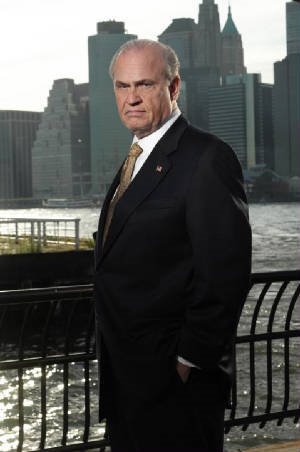
Former U.S. Senator (R-TN)
