A VICTORY IN THE FIGHT FORCAMPAIGN FINANCE REFORM
by
Senator Fred Thompson (R-TN)
April 6, 2001
Recently, the Senate took a major step to change the message we are sending to the American people. By a 59-41 vote, we passed the McCain-Feingold Bipartisan Campaign Reform Act of 2001. The McCain-Feingold bill bans soft money contributions, restricts corporate and union spending on campaign ads, and provides greater disclosure and stronger elections laws.
When I ran for office in 1994, I promised to try to change the way Washington works, including the way we finance our federal campaigns. In 1995, I cosponsored the original legislation introduced by Senators John McCain (R-AZ) and Russell Feingold (D-WI) to ban "soft money" -- the unlimited and unregulated sums of money that flow into political parties. Soft money was originally intended for grassroots party building activities that didn't benefit individual campaigns. Now the political parties are just a conduit for soft money, which goes almost directly to assist individual campaigns.
We were unsuccessful in our initial effort to pass campaign finance reform and the problem got worse. The ability to use soft money to fund sham issue ads created a non-stop money chase that resulted in hundreds of thousands of dollars being exchanged for access to the highest levels of government. The final report of our Senate Governmental Affairs Committee Special Investigation in 1997 documented numerous examples of apparent and actual corruption involving soft money. In 2000, the national political parties took in unregulated soft money contributions totaling almost half a billion dollars.
Even where there is no wrongdoing, there are still serious appearance problems when you have all that money going to the parties to be spent on individual candidates when Congress is considering important pieces of legislation. It seems every time we debate an issue we read about how much money those affected by it have donated to the parties. When this occurs, we are all diminished. The American people cannot trust a government they believe is influenced by large corporations, labor unions, and a few wealthy individuals. Due to the soft money chase, we have moved from a system based on many small contributors to one based on a few huge contributors.
I am increasingly concerned that the people we were elected to serve have lost faith in the political process. Too many people do not even bother to vote because they suspect that their voices are drowned out by five- and six-figure donations. I believe passage of McCain-Feingold will help change that. We can help restore the public's confidence in the way we fund our elections by eliminating these massive, unregulated soft money contributions.
While we move to rid the political system of special interests' soft money, we should find a way to increase the regulated "hard money" contribution limit. The costs of running a campaign have increased ten-fold since the $1,000 hard money contribution was put in place in 1974. In order to bridge this disparity, Senator Dianne Feinstein (D-CA) and I sponsored an amendment to the McCain-Feingold bill that increases the amount of "hard money" individuals can contribute to candidates from $1,000 to $2,000 and indexes it for inflation.
Hard money is the most legitimate and most fully disclosed way for individuals to financially support a candidate. The $1,000 hard money limit had not been raised since 1974 and, given the increasing cost of advertising, was making it difficult for anyone other than incumbents and millionaires to effectively get their message to the voters. Now, a challenger will have an easier time raising the legitimate money needed to compete. The higher limit will also allow members of Congress to spend less time fundraising and more time legislating.
I am proud to be a part of this bipartisan effort to reform our campaign finance system. The McCain-Feingold bill is an important first step in restoring the public's trust in their government and in their elected officials.
http://web.archive.org/web/20020626121129/thompson.senate.gov/press/2001/columns/040601.html
Saturday, April 28, 2007

Weekly Column 03-30-01
TAX FAIRNESS FOR TENNESSEE
by
Senator Fred Thompson (R-TN)
March 30, 2001
Tennesseans are discriminated against under federal tax laws simply because our state chooses to raise revenue primarily through a sales tax instead of an income tax. Federal law enables taxpayers to deduct their state income tax from their federal tax liability, but not their state sales tax. That's unfair.
Therefore, residents of eight states are treated differently from residents of states that have an income tax. Six states ? Texas, Wyoming, Florida, South Dakota, Washington, and Nevada ? have no state income tax. Two states ? Tennessee and New Hampshire ? only impose an income tax on interest and dividends, but not wages. Tennesseans pay more than $750 million more in taxes to the federal government each year than they should because of this inequity in the tax code.
I have introduced legislation that will address this by allowing taxpayers to deduct either their state and local sales taxes or their state and local income taxes on their federal tax forms, but not both.
Prior to 1986, taxpayers were permitted to deduct all of their state and local taxes paid (including income, sales and property taxes) when computing their federal tax liability. The ability to deduct all state and local taxes is based on the principle that levying a tax on a tax is unfair. In 1986, however, Congress made dramatic changes to the tax code. The Tax Reform Act of 1986 significantly reduced federal tax rates on individuals. In exchange for these lower rates, Congress broadened the base of income that is taxed by eliminating many of the deductions and credits that previously existed in the code, including the deduction for state and local sales taxes. The deduction for state and local income taxes, however, was retained.
It's long past time to restore equity for persons living in states without an income tax. My legislation would do this in a fair and simple manner. Under the legislation, persons claiming a deduction for state and local sales taxes would simply have to refer to an IRS chart to determine the amount they could deduct. The amount of the deduction would be based on a taxpayer's income and family size. This way, taxpayers would not be burdened with keeping track of their receipts all year.
Passage of this legislation won't be easy, as only eight other states share Tennessee's situation, but it's an effort we must undertake. Similar legislation has been introduced in the House and the Tennessee delegation is working in a bi-partisan manner to generate support for our effort.
I believe that our federal tax laws should be neutral with respect to the treatment of state and local taxes. The current tax code is biased in favor of states that raise revenue through an income tax. I strongly support comprehensive reform of the tax code that will address issues such as neutrality, fairness and simplicity. As we work to reform the overall tax code, restoring equity in this area should be a part of the discussion.
http://web.archive.org/web/20021020105534/thompson.senate.gov/press/2001/columns/033001.html
Weekly Column 03-16-01
ADDRESSING INHERITED MANAGEMENT PROBLEMS WILL BE VITAL TO BUSH ADMINISTRATION'S SUCCESS
by
Senator Fred Thompson (R-TN)
March 16, 2001
The Bush Administration begins with an array of pre-existing management problems of unprecedented depth and breadth that will severely test the President's ability to achieve his policy goals. The federal government's core management problems have persisted for years and, in fact, have grown worse. In 1990, the General Accounting Office (GAO) launched its biennial ?high risk list' with 14 problem areas. The list issued this year contains 22.
We're living on borrowed time. Peace and prosperity mask a lot of these problems, but that won't always be the case. When we no longer have peace and prosperity, who's going to trust the federal government if we've eroded public confidence by failing to address these problems?
There are four overarching areas that I believe are the most pervasive and critical:
Financial management. Poor financial management wastes billions of taxpayer dollars each year. No one knows how much because the federal government makes no comprehensive effort to keep track of it.
Information technology management. Advances in information technology have yet to register with the federal government. In addition, weaknesses in government information systems make them vulnerable to computer attacks. This vulnerability poses national security threats and jeopardizes the confidentiality of sensitive information on individuals the government holds.
Human capital management. Recent government downsizing has been conducted without any strategic planning for the workforce needs of the 21st century. As a result, agencies lack workforces with the necessary skills and experience to perform their missions.
Program overlap and fragmentation. The federal statute books are full of programs created randomly over the years in response to the real or perceived needs of the moment. Once created, however, it is virtually impossible to eliminate them even if they have long since ceased serving their purpose.
These problems cause hardships for all Americans. Human capital weaknesses threaten the Social Security Administration's ability to serve the public. Beneficiaries often can't get accurate information by phone and wait hours for appointments. Flight delays have more than doubled over the last five years, yet our air traffic control system is based on archaic technology. Many programs lose significant portions of their budgets to waste, fraud and abuse.
The tools to fix these problems exist, however, via management improvement laws enacted by Congress over the last decade and recommendations provided by the GAO and the various agency inspectors general. However, the missing ingredient up to now has been leadership and sustained commitment from the President and Congress.
The President must make clear in word and deed that resolving these management problems is one of his priorities, and that he will keep after the agencies and the Office of Management and Budget (OMB) until the job is done. OMB and the agencies must then follow up and establish specific performance goals, strategies and timetables to meet them. In addition, agencies must identify, and Congress must provide, the funding needed to resolve the problems. However, funding must be linked to results.
I believe that the federal government should be smaller, more efficient, and more accountable to the American people, and I was very encouraged by early indications that the Bush Administration is taking management and performance improvement seriously. OMB Director Mitch Daniels recently instructed agencies to develop performance goals to implement the President's management reform initiatives and to resolve their mission-critical problems. Likewise, the preliminary budget blueprint that the Administration put out last week has more to say on management improvements than anything I've seen in years.
During the 107th Congress, the Governmental Affairs Committee, which I chair, will work to encourage and support those efforts.
http://web.archive.org/web/20020527145313/thompson.senate.gov/press/2001/columns/031601.html
Weekly Column 02-16-01
A Two-Pronged Approach to China
by
Senator Fred Thompson (R-TN)
February 16, 2001
Many experts are now focusing on China's future. The optimists point out that with the advent of the Internet, modern telecommunications and free trade, China will become more free and open. Pessimists, on the other hand, remind us that China is an emerging power, and that emerging powers more often than not try to change the realities of the world around them.
An unsettling Chinese white paper on national defense released last November characterized the United States as a global menace and a threat to peace. And a Defense Department report on China's military power, which was delivered to Congress last year, said that China's leaders have been discussing ways to counter U.S. power, including accelerating their military modernization, pursuing strategic cooperation with Russia, and increasing China's weapons proliferation activities abroad.
No one is sure how China will evolve, but we do know that we must try to engage China in trade, hope for democratic change, and remain firm on our policies, priorities, and interests. Unfortunately, over the last eight years, when it came to Chinese military money going to the Democratic National Committee, China's theft of the designs of our most sophisticated nuclear warheads, or Beijing's threats against Taiwan, the Clinton Administration's response was usually inadequate. And in each case, a timid U.S. response led to a more assertive China.
President Bush is correct when he says that China is neither our enemy nor our strategic partner; China is clearly our competitor. While we are troubled by their proliferation record, regional assertiveness, and threatening statements toward the United States and our friends in Asia, we can be encouraged by the Chinese people's desire for greater political freedom, individual rights, and reform.
Like many, I believe that increased trade and engagement may help open up China in the long run and give the Chinese people the means to bring about political, social, and economic reform. But, at the same time, I believe we must be clear and consistent about our commitment to universal principles such as human rights and religious freedom and our desire to advance the rule of law and democracy.
The United States must also welcome China into the World Trade Organization, for its participation is important to our long term economic growth and China's long term political reform. While doing so, we must demand that Beijing stick to its agreements, abide by the rules of the WTO, and support Taiwan's entry into the WTO at the same time.
The U.S. walks a delicate tightrope as it balances national security, foreign policy and trade with China. Free trade and open markets are essential to continued prosperity, and promoting our values abroad are also important, but our national security cannot be sacrificed for the promise of future profits. Nowhere is this choice between trade and security more difficult, or more important, than in the area of China's continued proliferation activities, including its diversion of sensitive, commercially-available "dual-use" technologies.
We must be clear to the Chinese that the U.S. will not tolerate the continued transfer of dangerous items to rogue states and others, or for China's own military modernization efforts. After all, at a time when China is being invited to become a member in good standing of the global trading community, is it asking too much for a fellow permanent member of the U.N. Security Council to obey international rules and norms with regard to the proliferation of weapons of mass destruction and other technology? For example, the Bush Administration has recently confronted the Chinese about the sale of fiber-optic cables to Iraq in violation of U.N. Security Council resolutions. Administration officials point out that the fiber-optic cables provided by the Chinese would link Iraqi anti-aircraft systems and endanger U.S. and British pilots enforcing no-fly zones over Iraq.
Next, the United States should deploy as soon as technologically possible a robust, multi- tiered missile defense system that will protect us against ballistic missiles from rogue states like North Korea. Beijing is deeply concerned that a NMD will nullify its own plan and could even lead to missile defenses for Taiwan. Nonetheless, the bottom line is that the United States must act in its national interests to protect our country.
Finally, the United States needs to dedicate more resources and attention to bolstering our intelligence capabilities; tightening security at our national labs, facilities, and federal agencies; and strengthening our export controls. And we must ensure that our armed forces are the best trained and equipped in the world and that they are able to meet the new, technically sophisticated threats that are emerging.
It goes without saying that we do not want a shaky relationship with a country as important as China to degenerate further. It is equally obvious that turning a blind eye toward activity that is harmful to our interests has not improved our relationship with China. We must demonstrate strength as well as restraint to them and the rest of the world. We cannot afford to take one approach without the other.
http://web.archive.org/web/20020626120632/thompson.senate.gov/press/2001/columns/021601.html
Weekly Column 02-09-01
Help for Our Local Heroes
by
Senator Fred Thompson (R-TN)
February 9, 2001
Among the new proposals President Bush introduced during his first few weeks in office, one in particular may change the way we provide help for those in need. Last week, President Bush proposed a new White House Office of Faith-Based and Community Initiatives and introduced a plan to allow faith-based organizations to compete for federal funding for social services.
Private charities are the cornerstones of many communities' efforts to help their citizens in need. Over the years, research has proved that faith-based organizations are successful in reducing addiction, abuse and juvenile crime. Many communities, as well as state governments, have their own faith-based initiative programs. Faith-based programs and organizations have a long history of successfully reaching out to Tennesseans who need their help, including at-risk youth, the poor, or those addicted to illegal drugs.
For example, St. Luke's Community House serves families in a largely low-income district of West Nashville. St. Luke's was founded by Daughters of the King and provides care for children, counseling for families, and services for senior citizens, among its many important functions. St. Luke's operates solely on volunteer support and donations.
Under President Bush's plan, St. Luke's and thousands more faith-based community groups will be able to compete with non-faith-based organizations for federal funding under the expansion of the Charitable Choice plan. Currently, Charitable Choice allows faith-based groups to compete on equal-footing for federal welfare funds while forbidding religious discrimination against the recipients of the services. President Bush believes that, just as Charitable Choice worked as part of welfare reform, the federal government should not impede the efforts of private charities or discriminate against faith-based institutions as long as the organizations provide social services and do not promote religion.
The White House Office of Faith-Based and Community Initiatives (OFBCI) and parallel offices in a number of federal agencies will examine areas where executive action, legislation, or regulatory relief will lend a hand to faith-based organizations that are successfully serving the needy in Tennessee and across the nation.
The Bush Faith-Based initiative will also encourage charitable giving by expanding the charitable deduction for the 80 million taxpayers who don't itemize on their tax returns. It will allow penalty-free IRA withdrawals from individual retirement accounts (IRAs) for charitable contributions.
I believe that we should stop spending billions of dollars on programs we don't know are working and allow faith-based programs to compete for this funding. These programs can work, and the federal government can set this initiative up in a way that satisfies Constitution requirements. President Bush's proposal for the Faith-Based initiative is an example of what can happen when government decision-makers search for creative approaches to building effective social programs.
Across America, community organizations like St. Luke's are lifting people out of poverty and despair, one act of compassion at a time. These unsung local heroes can't reach every needy person because the government has not viewed them as partners in the fight to improve the quality of life for these Americans. President Bush's plan will remove the barriers that prevent community and faith-based groups from feeding the hungry, fighting crime, strengthening families, and overcoming poverty.
http://web.archive.org/web/20020627063715/thompson.senate.gov/press/2001/columns/020901.html
Weekly Column 01-24-01
Restoring Faith in Our Political System
by
Senator Fred Thompson (R-TN)
January 24, 2001
Lawmakers have a breach to repair with the folks who sent them to Washington to do their business. With each election, we see more disenchanted voters, fewer young voters, and greater cynicism than in the one before. There's one explanation for this disenchantment---there's too much unregulated money in politics.
If lawmakers are going to regain the trust of the American people, we are going to have to repair a broken system of financing our election campaigns. Our current system of money and politics serves no one well, and it furthers some Americans' belief that their votes and participation in our democracy don't count. That's certainly not what the Founding Fathers envisioned, and it's not a situation that we can ignore.
This week I joined a bipartisan coalition including Senators John McCain (R-AZ), Russell Feingold (D-WI), Thad Cochran (R-MS), and others to introduce the Bipartisan Campaign Reform Act of 2001.
I have long been a supporter of campaign finance reform and joined Senators McCain and Feingold when they first began the battle to rid our election system of the unregulated and unlimited contributions to political parties called "soft money" back in 1995. But this time around, the fight seems different. We've been joined by a number of others who believe, like we do, that it is time to get rid of these large, unregulated "soft money" contributions that leave so many Americans with the feeling that they don't have a say in their government's agenda. More Americans than ever seem to feel that this is a fight worth taking up, and they're asking their members of Congress to support campaign finance reform. It seems like the tide is turning.
In the last election, both national political parties saw unregulated contributions of up to $500,000. Our legislation will put a stop to the practice of raising these exorbitant, unlimited amounts of "soft money" by prohibiting all such contributions to the national political parties from corporations, labor unions, and wealthy individuals.
If you watched television at all in the months preceding the November presidential election, you probably noticed the ads funded by corporations and unions. These ads stuck to the letter of the law by avoiding the use of appeals to "vote for" or "vote against" a particular candidate, but they violated the spirit of the law by disguising their appeals as issue ads. McCain-Feingold-Cochran will address the spiraling proliferation of these ads by prohibiting labor unions and for-profit corporations from spending their treasury funds on "electioneering communications" within 30 days of a primary election and 60 days of a general election.
The bill will also strengthen existing law to ensure that foreign money stays out of the American political system. It will prohibit foreign nationals from making any contributions in a federal, state, or local election.
Finally, the legislation will bring greater transparency and strength to our election laws by improving the disclosure of campaign finance information and strengthening the enforcement of the law. It will provide for more timely disclosure of independent expenditures and clarify the circumstances under which activities by outside groups are considered to be coordinated with candidates. The legislation will bar federal candidates from converting campaign funds for personal use, and it will strengthen current law to make it expressly clear that it is unlawful to raise or solicit campaign contributions on federal property.
Individually, I plan to work on increasing the "hard money" limits. Not only have our "hard money" limits fallen behind in terms of the enormous expenses attendant to running a campaign, but the focus of campaigns has changed from "hard money" to "soft money" to independent ads in the last election. McCain-Feingold-Cochran addresses these areas, but we can do more. I plan to pursue an increase in the "hard money" limits because I believe it will help counter the increasing influence of independent groups. The current "hard money" limit, the maximum amount an individual can contribute to a candidate, was set at $1000 in 1974 and has never been increased to reflect inflation. Increasing the contribution limit will help candidates facing wealthy, self-financed candidates and will allow members of Congress to spend less time fundraising and more time legislating.
We just witnessed one of the closest elections in American history. It taught us that now, more than ever, every vote counts. So it's time to rid Washington of even the semblance of corruption by cleaning up the way we finance our campaigns. I believe that the Bipartisan Campaign Reform Act is a good framework to do so, and I'll continue working with my colleagues on both sides of the aisle to make some significant progress on this issue.
http://web.archive.org/web/20020626115738/thompson.senate.gov/press/2001/columns/012401.html
Weekly Column 01-17-01
U.S. Intelligence in the 21st Century
by
Senator Fred Thompson (R-TN)
January 17, 2001
On August 31, 1998, North Korea test-fired a missile with the potential of striking U.S. territory. Though our intelligence community was aware of a possible missile launch, it was surprised when the missile sported a third stage, allowing it to travel much farther than expected. Our intelligence analysis on the missile's capabilities had been woefully incomplete. Most recently, the terrorist attack on the U.S.S. Cole was a tragic reminder of the need for detailed and timely intelligence of current threats. These failings put our nation at risk and demonstrated the need for reform within our intelligence community.
When the Berlin Wall fell and the Soviet Union collapsed, many believed that the United States, as the world's sole remaining superpower, could afford to cut back on its intelligence gathering operations. In fact, some went as far as to propose dismantling several of our intelligence agencies. Beginning in 1993, the intelligence community was forced make serious budget cuts, which limited their recruitment of new sources, restricted their analysis of intelligence information, and postponed the modernization of their surveillance and communication systems. These shortfalls resulted in an overall decline in our intelligence capabilities.
The end of the Cold War, however, has not brought a decrease in assignments for our intelligence services. Rather, they have experienced an unprecedented growth in their responsibilities. During the last half of the twentieth century, our intelligence agencies focused primarily on monitoring Soviet military power; today, we focus on numerous threats---the rogue states and others---and on a wider variety of issues. The intelligence community is now required to report on the proliferation of weapons of mass destruction by supplier states, the development of ballistic missiles by rogue nations, the activities of terrorist groups, and the smuggling of illegal drugs. And intelligence officials provide critical information on diplomatic negotiations, regional conflicts, and impending crises. These new assignments have required the intelligence community to reinvent itself with new goals, purposes, and means.
Over the last five years, Congress has expressed considerable concern about the erosion in our country's intelligence capabilities. In particular, the Senate Select Committee on Intelligence (SSCI), which is one of two congressional committees responsible for overseeing our intelligence agencies, has worked hard to reverse this trend. In the past, the SSCI has taken the lead on reforms that have improved our intelligence agencies' collection and analysis capabilities, improved the protection of classified information, eliminated the duplication of work, and streamlined costs. Most recently, the SSCI advocated increased funding for modernization and investments in intelligence gathering resources; the restructuring of some of our more convoluted agencies; and the reduction in government waste.
I am honored to the have opportunity to join the Senate Select Committee on Intelligence in the 107th Congress. This new assignment will build upon my experience as a former member of the Foreign Relations Committee, and now, as the Chairman of the Senate Governmental Affairs Committee. And it will be provide an excellent opportunity to keep working on tightening U.S. export controls, enforcing sanctions laws, responding to the proliferation of weapons of mass destruction, and developing a National Missile Defense.
This year, the Senate Select Committee on Intelligence is expected to look at new ways to further enhance our nation's intelligence capabilities. As a member of the committee, I look forward to working with my colleagues to secure additional funding for more human intelligence; the modernization of our electronic surveillance assets; and the purchase of advanced communications systems. On the policy side, we'll look at ways to help the intelligence community increase its support for military operations; upgrade security at our weapons facilities; better protect its classified information; and implement more effective management, accountability, and reporting standards.
As we enter the twenty-first century, the United States is, without a doubt, the world's preeminent economic, military, and political power. While few countries will risk a direct confrontation with the U.S., there are many that seek to challenge us indirectly through terrorism, espionage, and cyber-attacks. Our intelligence agencies are our first line of defense against such attacks. As the North Korean missile launch clearly demonstrated, and the attack on the U.S.S. Cole reminded us, there is still much that must be done. Our intelligence agencies need a boost, and it is time to provide it.
http://web.archive.org/web/20021020110727/thompson.senate.gov/press/2001/columns/011701.html
Weekly Column 01-10-01
THREAT OF WEAPONS PROLIFERATION CONTINUES
by
Senator Fred Thompson (R-TN)
January 10, 2001
The Pentagon recently released a report entitled "Proliferation Threat and Response," which details the nuclear, chemical, and biological weapons programs that threaten the United States and the Department of Defense?s response. It should come as no surprise that the threats to the United States are rising, and entities in Russia and China remain the worst offenders. Worse yet, our military remains largely unprepared to meet such a threat.
The report states that many of the world?s rogue nations?North Korea, Iran, Iraq, and Libya, for example?have made aggressive efforts to obtain weapons of mass destruction (WMD) and the means to deliver them. Communist North Korea is also a key supplier state of ballistic missiles and may be providing other rogue states with the material necessary to build nuclear weapons. This report claims that the prospect of these weapons and material falling into the hands of terrorists or extremist groups is increasing.
As this report clearly illustrates, proliferation continues to pose a clear and present threat to the security of the United States. And this is not the first such report. Last year, a separate analysis from the U.S. intelligence community stated that China transferred missile technology to Libya, provided missile-related goods to North Korea, and may still be providing secret technical assistance to Pakistan's nuclear programs. The report added that Russia was providing Iran with missile and nuclear technology?items which threaten U.S. interests, forces, and allies in the Persian Gulf region. In many of these cases, the Clinton Administration either ignored the facts, failed to take action in accordance with U.S. law, or sought new "agreements" that were either ineffective or rarely fulfilled.
That is why I introduced legislation last year that would provide an annual review of proliferation by key supplier states, outline the United States? response to these activities, and require sanctions under U.S. law to stem the proliferation of weapons of mass destruction, missile technologies and advanced conventional weapons by key supplier countries. The legislation, "The China Nonproliferation Act," would require the President to impose non-trade related sanctions on individuals, companies, and groups if he determines that violations have occurred. Unfortunately, this bipartisan effort was derailed last year during the debate over granting Permanent Normal Trade Relations (PNTR) to China.
Nations have also advanced their WMD and ballistic missile programs by diverting commercial technologies such as high-performance computers and wind tunnels toward military applications. China, for example, has misused sensitive "dual-use" technologies, which were legally acquired from United States corporations, to further its military modernization and nuclear weapons programs. Many rogue states and terrorist groups are doing the same. The diversion of high-technology items and know-how for military and illegal uses must stop. The best way to do this is to strengthen our export control laws and regulations, improve our export review procedures, and provide federal agencies with the resources and authority they need to do their jobs.
The Department of Defense (DoD) has made some progress in countering these threats, particularly with the creation of the Defense Threat Reduction Agency, whose primary mission is to protect our country from WMD threats. But more must be done. Our nation continues to lack sufficient resources for critical WMD defense programs, including medical biological defense, domestic emergency coordination, and ballistic missile defense. DoD?s organizational structure in this area remains convoluted. International efforts have shown only limited results, and coordination with state and local agencies on a domestic response has been spotty.
The "Proliferation Threats and Response" Report by the Department of Defense is the latest in a long list of evidence that the world remains a dangerous place. It is clear that the United States must take tough and immediate action to curb the proliferation of nuclear, biological, and chemical weapons and ballistic missiles.
During this session of Congress, I intend to work hard to strengthen our export control laws and make our licensing procedures more efficient. I?ll be focused on giving our intelligence community the resources it needs and ensuring that the United States develops a robust national missile defense system that can protect America. I also believe that the Congress needs to consider legislation that will make the activities of the world?s worst proliferators, and the United States? response, more transparent and open to public scrutiny. Only by taking action today to prevent the further spread of these dangerous weapons and technologies can we ensure the safety of our country and our families tomorrow
http://web.archive.org/web/20021002074905/thompson.senate.gov/press/2001/columns/011001.html
Weekly Column 01-03-01
CONSENSUS FOR AMERICA'S STUDENTS
by
Senator Fred Thompson (R-TN)
January 3, 2001
America's ability to compete in a global economy hinges in no small part on the education and preparation of our nation's school children. They are our most precious resource, and we have to do everything we can to give them the tools and the education they deserve.
This is a premise on which everyone can agree, but an astounding 40 percent of American fourth graders still can't read at the basic level. American twelfth graders rank dead-last in advanced physics when compared with students in 18 other countries. And one-third of college freshmen have to enroll in a remedial class---either in reading, math, or writing.
While our schools need more flexibility at the local level to deal effectively with the problems facing our educators and our students, there is a federal role in the fight to provide a quality education for each and every student in America. But it's not the traditional role of top-down federal mandates that fail more and more of our students each year; rather, we at the federal level need to focus on achieving a bipartisan consensus on initiatives that will promote flexibility and accountability. These initiatives should guide local administrators and teachers in measuring results, so they can praise success and confront failure.
Fifty years ago the biggest obstacle to classroom learning was talking out of turn or chewing gum in class. Today our students face things like school violence, drug abuse and teen pregnancy, but the specific challenges vary from classroom to classroom, school to school, state to state. So cumbersome one-size-fits-all mandates from Washington are not working. That's why Republicans and Democrats in Congress are united behind the concepts of flexibility and accountability as the keys to results.
As the 107th Congress commences, we'll be focused on President-elect George W. Bush's proposal to increase educational flexibility at the local level. He proposes that we reduce the number of categories of federal education aid from more than 50 to five, cutting the number of hoops an administrator must jump through and giving states the flexibility to implement the education reforms that meet their students' needs. The plan expands schools' freedom by consolidating funding into one of five categories: improving academic performance of disadvantaged students, English proficiency, teacher training and recruitment, student safety, and parental choice and innovative practices.
The Bush plan will also increase federal education funding for the programs in these five categories by $25 billion over five years. Specifically, the additional funding would support important initiatives like Bush's "Reading First," a concentrated and systematic approach to making sure every child reads by the third grade by identifying early reading problems and getting children the help they need to read at age-level. It will include diagnostic tests, intensive teacher training, and summer school and after-school reading programs.
Under the Bush education plan, greater flexibility and more education funding are the cornerstones of increased accountability. State testing of every student in grades three through eight every year in math and science will help ensure that they're on track. The results will be quantified through school report cards and will yield financial incentives for states that demonstrate sustained student improvement. Schools that don't improve will see their funds reduced. In short, President- elect Bush's plan will redefine the relationship between the states and the federal government by granting freedom from regulation in exchange for results.
Education will determine America's success or failure in the global economy. If we want better schools, safer schools and children who know right from wrong, the federal government has a role: providing teachers, administrators and parents with the flexibility and the funding to get the job done and then holding them accountable if they don't.
Congress is ready to work together with President-elect Bush to create the kind of 21st century education system that our children deserve. It's about time.
http://web.archive.org/web/20020626120100/thompson.senate.gov/press/2001/columns/010301.html
Fred Talks Sports
The Draft
Sports, friends, sports.
By Fred Thompson
I’ve been a dedicated fan of professional football since I was a kid. I have the “premium” satellite football package and I’ve had seats for Tennessee Titans games since they first came to Nashville. So you can probably guess what I’ll be doing this weekend. Like a lot of other fans, I’ll be listening to draft guru Mel Kiper Jr., as the NFL draft plays out in New York. This year, though, the process of player selection has taken a decidedly political turn. You might even think it was taking place in Washington. D.C., with the league scolding teams for leaking personal information about prospective players, such as admissions of marijuana use. There have even been reports that top draft picks have been tailed for weeks by private detectives looking for signs of character flaws.The backstory for this new focus on off-field behavior, of course, is the disastrous public-relations season the NFL had last year. So let me turn my attention for a moment from more pleasant topics, like how great Vince Young will be with a year under his helmet, to ask the league brass a few questions. Here’s one" Why do these teams keep drafting players with character defects you can see at 100 yards in the dark with your back turned?To use a phrase increasingly familiar to NFL players: Your honor, I give you “Exhibit A” — in this case, one Adam “Pacman” Jones, the sixth overall pick of the 2005 draft. Pacman plays (or did play) cornerback for the Titans. Watching him return a punt through tacklers was like trying to watch a bullet ricochet. As a wag once said about a young baseball player: He can turn out the light and be in bed before it’s dark. Unfortunately, Pacman seems to think his talent entitles him to behave like one of Tony Soprano’s cousins. In his brief career, he’s probably already cost the Titans games with his “look at me” celebrations and cheap-shot penalties. His on-field behavior, though, is a model of decorum compared to what he’s done off the field — including reports of assault (twice), disorderly conduct, vandalism, marijuana possession and taking a swing at a police officer. Finally, as most football fans and all Titans boosters know, Jones and his entourage invaded a strip club (the usual scene of his hooliganisms) during this year’s NBA All Star Weekend in Las Vegas. There, he reportedly “made it rain” by showering the ladies with a satchel full of more than $80,000 in dollar bills. Apparently, some of the performers thought the money was meant for them and started picking it up. Pacman, however, thought he was going to get it back and a disagreement ensued. Naturally, this called for gunplay and someone — whom the club owner says was part of Pacman’s group, though the cornerback denies it — shot three people and left a 43-year-old security guard paralyzed below the waist for life. This was too much even for the NFL, which booted Pacman from the 2007 season. Unfortunately, this was not the only stain on the sport last year. Nine Cincinnati Bengals, trying perhaps for at least one year-end record, were arrested. Maybe their parole officer ought to have a desk in their locker room. So here are a few more questions: Has there ever been a case where a young player first showed his penchant for getting arrested on a regular basis only after turning pro? I doubt it. Similarly, are NFL teams operating under the assumption that having a few million dollars of spending money in their pockets is going to make better citizens out of these guys? The drill must go something like this. On draft day, they look at a young man’s talent. Then they look at his rap sheet. Then someone evidently concludes, “He’ll be better when he’s with me. He’ll change.” That’s right — same line used by starry-eyed, self-deceived brides — same results.Then the athlete is drafted and the problems resume — arrest, headlines, lawyers, team meetings, arrest, apologies, civil suits, suspensions, more apologies, rationalization by team and finally, as in Pacman’s case, the loss of an entire season. So this is my last question for the teams this year: Wouldn’t it make more sense to draft a kid with just a little less talent, but a bit more understanding of just how fortunate he is to be playing in the big leagues? There are a lot of kids out there who idolize star players and will copy their behavior — whether it is good sportsmanship or hanging out at crime scenes. In the long run, though, it may be purely business that teaches the league the cost of benching morality. The Titans, after all, are going to play a year without one of their best players. I wonder what that’s going to do to their bottom line.
http://article.nationalreview.com/?q=MDQwYmI1OGQ0NWM0NTFlMDA1MGE1NGExMDRiMTc2Y2U=
Working For Tennessee- 2002
Working for Tennessee
Since his election to the United States Senate in 1994, Fred Thompson has been working to make sure that Tennesseans and issues important to Tennessee are well represented in our nation?s capital. Whether listening to constituents in visits to all 95 Tennessee counties, or debating issues on the Senate floor in Washington, Senator Thompson is doing the business of Tennessee.
He pushed legislation to protect 2,000 civilian Tennesseans working on the Kentucky side of Fort Campbell from being forced to pay unfair Kentucky state taxes. As Chairman of the Senate Governmental Affairs Committee at that time, his hearings on the issue led to long-sought relief.
After a spring trip to our nation?s most visited national park, Thompson founded the Great Smoky Mountains National Park Congressional Caucus to raise the profile of the park in Congress and with the National Park Service. Recognizing the challenges faced by a park, which receives 10 million visitors a year, Thompson helped pass legislation allowing the park to keep 100 percent of the fees collected within--up from 80 percent. He worked with the Park Service on an agreement allowing the Friends of the Smokies to keep their donation boxes in the park, and helped secure much-needed resources for trail maintenance and a study of the park?s air quality.
When the Senate considered the increasing funding for highways, Thompson worked to make sure Tennessee received the federal investment it needs for safe roads and bridges. In the past, Tennessee motorists have paid significantly more in federal highway user taxes than the federal government gave back for construction, repairs and maintenance. Thompson made sure that Tennessee drivers will get a fair share, and a commitment to safer roads.
In the 1998 and 1999 budgets, Thompson convinced the Senate to continue funding for the Tennessee Valley Authority to carry out its important land and water stewardship activities, paid for by the federal government in all other parts of the country. When the Clinton Administration and the House of Representatives made the decision to slash funding, Thompson returned with a proposal to allow TVA to refinance its federal debt and save ratepayers millions each year. This refinancing proposal was enacted into law.
Whether in the arena of research and development or defense work vital to our national security, Thompson has long been a supporter of the important work being done at Oak Ridge. Due to his efforts, Congress has provided funding for the initial construction of the Spallation Neutron Source, a billion dollar project which will provide 2,300 jobs during construction, and 1,500 permanent jobs at Oak Ridge.
In addition, Thompson helped secure critical funding for infrastructure upgrades at the Y-12 plant, passed an amendment naming Y-12 a ?National Prototype Center,? and helped pass an amendment prohibiting the president from choosing Oak Ridge as a temporary dumping site for spent nuclear fuel.
As a member of the Senate Judiciary Committee, Thompson urged passage of copyright term extension legislation protecting songwriters. In addition, he helped expedite Senate confirmation of qualified Tennesseans for the federal bench, including Ron Gilman in the Sixth Circuit, Aleta Trauger as the first woman appointed to Tennessee?s Middle District, and Bernice Donald to the Western District. Judge Donald is the first African-American woman ever to sit on the federal bench in Tennessee. And to ease the pressures of severe overcrowding, Thompson pushed through funding for construction of a new federal courthouse in Greeneville.
To protect Tennessee?s farmers, Thompson supported emergency funding during economic hardship, and opposed a massive tobacco tax increase.
To preserve Tennessee?s rich historical legacy and treasured natural resources, Thompson successfully persuaded Congress to invest in the fight against erosion at Shiloh National Military Park, and helped pass legislation authorizing the federal government to purchase land for the Chickamauga-Chattanooga National Military Park.
As a result of an adverse pipeline decision in Marion County, Tennessee, Thompson introduced legislation guaranteeing that property owners receive personal notice, by certified mail, when a private company is seeking the right to acquire an interest in their land through the power of eminent domain. As a result, the Federal Energy Regulatory Commission has announced its intention to adopt a system that closely follows the Thompson bill.
Thompson recognizes the need to protect tourism and travel in Tennessee. In 1998 the Senate passed legislation he cosponsored to bring more air service to underserved communities such as Chattanooga and the Tri-Cities, helped secure funding for a ?New World Runway? in Memphis, and cosponsored a Senate resolution calling on the President to end the Northwest Airlines strike.
Believing that resources should not be wasted, Thompson successfully authored an amendment providing for the transfer of 1,000 acres at the Volunteer Army Ammunition Plant to the City of Chattanooga and Hamilton County, making it available for immediate economic development.
In addition, when the U.S. Postal Service was considering relocating its Southeastern Regional Headquarters to Atlanta, Thompson intervened to save 87 jobs in Memphis.
From saving jobs in Tennessee to protecting farmers and preserving Tennessee?s natural resources, Fred Thompson has proven his dedication to one purpose in Washington: working for Tennessee.
http://web.archive.org/web/20021006211133/thompson.senate.gov/text/record2.html
Veterans- official position 2002
Veterans
The men and women who serve the United States agree to protect it both in times of peace and in times of war. They take great risks. They are often sent overseas and spend many months away from their family and loved ones. U.S. service members have answered this country's call, and they have done so willingly. In return, the U.S. promised that it would look after them once they put away their uniforms.
This country pledged to provide them with retirement pay, educational assistance, and secure, comprehensive medical coverage. The Congress has worked very hard to fulfill this promise. For instance, in 2001 the Senate passed legislation that will provide nearly $51 billion for the Department of Veterans Affairs, which is an increase of $1.1 billion over last year's budget. Much of this increase will be spent on improving medical care, expanding prescription drug coverage, providing better education benefits, and helping homeless veterans.
In a separate effort, the Congress passed a plan that would give military retirees who are 65 or older the option to remain in the Department of Defense's health programs. Medicare-eligible retirees are currently forced to leave the Defense Department's health program and either enroll in expensive private health care plans or rely solely upon Medicare. This policy change will allow them to use the Department of Defense's health care program as a "second-payer" to Medicare, potentially saving military retirees thousands of dollars a year. It will also make available to retirees additional prescription drug coverage.
Senator Thompson also introduced and passed legislation to restore GI Bill education benefits to those Vietnam War veterans who served our country faithfully but have been unfairly denied their much-deserved benefits. These veterans separated from the military for a short time and then later rejoined. Unfortunately, because of provisions in the 1984 Montgomery GI Bill, they were unable to qualify for education benefits. These provisions were unfair and denied benefits to thousands of veterans. Senator Thompson's legislation, which was signed into law by the President in January of 2002, corrects this injustice and honors America's pledge to its veterans.
Senator Thompson firmly believes the U.S. must keep its promises to veterans. Our men and women in uniform put their lives on the line for this country. Some suffered debilitating injuries as a result of their service. Some gave their lives. They sacrificed so that the American people would not have to. This country owes them its gratitude.
In addition, keeping this commitment to our veterans will help keep the military strong. The U.S. must make an extra effort to ensure that the needs of this country's military personnel are being met. If these needs are met, Senator Thompson believes that the military's morale and readiness will rise, and U.S. service members will be more likely to re-enlist, and encourage their friends and family to serve.
http://web.archive.org/web/20020816171719/thompson.senate.gov/text/veterans.html
China Nonproliferation Act- official position 2002
The China Nonproliferation Act
The world is a more dangerous place today because countries like the People's Republic of China (PRC) continue to proliferate weapons of mass destruction to rogue states like North Korea, Iran, and Libya. These rogue states are using many of these technologies to develop weapons of mass destruction and the means to deliver them, and Senator Thompson has repeatedly called for the immediate deployment of a multi-tiered national missile defense system to protect the United States.
In July 1999, shortly after North Korea surprised intelligence agencies by successfully launching a three-stage rocket over Japan and demonstrated the technological know-how to hit the United States with a small warhead, the bipartisan Deutch Commission concluded that the federal government is not ready to combat proliferation. And two unclassified CIA reports to Congress in 2000 confirmed that Chinese businesses provided missile-related items, raw materials, and/or assistance to rogue nations, including Iran, North Korea, and Pakistan. It also outlined Chinese support of Pakistan's nuclear and missile programs and explained how North Korea obtained materials for its ballistic missile programs from firms in China.
Many of these rogue states are also working to acquire "dual use" items from the West. Russian entities have provided Iran's missile programs with specialty steels and alloys, tungsten coated graphite, guidance technology, rocket engine and fuel technology, and laser equipment. And North Korea has provided missile technology and assistance to Iran and Libya and is reportedly building a missile factory in Sudan for Iraq.
Dangers to the United States clearly exist and are increasing. The unfettered sale of "dual use" and military-related technology aid those threats, and this problem is fueled by a few "key suppliers" like China. The U.S. walks a delicate tightrope as it balances national security and trade with China. Free trade and open markets are essential, but the federal government's first responsibility is our national security.
Senator Thompson introduced the China Nonproliferation Act, which requires an annual review of proliferation, establishes clear standards, reasonable penalties, adequate presidential waivers, congressional oversight, and much-needed transparency. The goal of Senator Thompson's legislation is to address the proliferation of key suppliers like China, Russia, and North Korea while minimizing any negative impact on U.S. businesses or workers.
Recently, on the eve of the Senate's consideration of Permanent Normal Trade Relations (PNTR) for China, it was revealed that China was assisting Libyan experts with that country's missile program, illegally diverting U.S. supercomputers for use in the PRC's nuclear weapons program, and helping build a second M-11 missile plant in Pakistan. And Iran successfully test-fired its Shahab-3 missile, which is capable of striking Israel, American troops in Saudi Arabia, or American bases located within the borders of our NATO ally, Turkey. The missile was developed and built with significant assistance from China.
Clearly, diplomacy alone will not resolve this serious threat to our national security. In a three week period in late June and July, no less than three senior U.S. delegations traveled to Beijing to discuss these issues. Each was sent back to Washington empty-handed, under the explicit threat that if the U.S. continues to assist Taiwan with its defensive needs, or proceed with our own National Missile Defense, the PRC will continue to proliferate offensive weapons and technology to whomever it pleases.
At a time of monumental change in the U.S. relationship with Beijing, Senator Thompson believes that it is not too much to ask that China obey international rules and norms with regard to the proliferation of weapons of mass destruction. His bill is a bipartisan approach that addresses the threat in a firm, responsible, and balanced manner. The China Nonproliferation Act will send the right message abroad by allowing for engaging and trading while establishing a framework for appropriate response to actions that threaten the United States.
Despite the fact that the China Nonproliferation Act was not adopted as an amendment to the legislation granting China permanent normal trade relations, Senator Thompson intends to continue to pursue the issue of nonproliferation, hold hearings, and introduce legislation that will ensure that the American people and United States interests are protected.
http://web.archive.org/web/20020811194254/thompson.senate.gov/text/cnpa.html
Tennessee Valley Authority- official position 2002
Tennessee Valley Authority
Senator Thompson has been a leader in the fight to ensure that the Tennessee Valley Authority (TVA) and its customers are treated fairly. In the face of opposition from the White House and the House of Representatives, Senator Thompson and Senator Bill Frist (R-TN) fought to preserve federal funding for TVA?s non-power programs. When it became clear that, although the Senate supported this funding, the House would not approve it, Senators Thompson and Frist successfully engineered passage of legislation allowing TVA to refinance the $3.2 billion in debt it owed to the Federal Financing Bank (FFB). This debt refinancing will save TVA over $100 million every year for the next decade ? more than enough to continue to fully fund its land and water stewardship responsibilities.
In addition, Senator Thompson supports the consensus ?TVA title? agreed to by TVA, all 159 of its distributors, and the Tennessee Valley Industrial Committee (TVIC) for inclusion in comprehensive electricity restructuring legislation being considered by Congress. Senator Thompson, Senator Frist, and Senator Thad Cochran (R-MS) have introduced this consensus title as a stand-alone bill in the Senate (S. 2570), and have urged their colleagues on the Senate Energy Committee and the Senate Environment and Public Works Committee to consider it as they debate TVA?s role in a deregulated environment.
During his time as Chairman of the Senate Governmental Affairs Committee, which has oversight responsibility over all federal agencies, Senator Thompson has also closely examined the management of TVA. Last year, Senator Thompson asked the General Accounting Office (GAO) to investigate an ongoing dispute between the TVA Inspector General (IG) and the TVA Board. After receiving the GAO report, Senator Thompson introduced legislation (S. 1707) to enhance the independence of the TVA IG by making this position presidentially appointed, rather than one that is hired and fired by the TVA Board. The Senate passed this legislation unanimously on November 19, 1999.
In addition, Thompson asked the GAO to examine issues surrounding the Center for Rural Studies, a $30 million irrevocable trust established by the TVA Board in 1994 and terminated a year later. The Governmental Affairs Committee is continuing its investigation into this matter.
http://web.archive.org/web/20020816090619/thompson.senate.gov/text/tva.html
Tennessee Tourism & Travel- official position 2002
Tennessee Tourism & Travel
Senator Thompson recognizes the need to protect tourism and travel in Tennessee, and has spoken on the topic to groups such as the Knoxville Tourist Bureau and the Tri-Cities Economic Summit. And he backs up his words with action.
In 1998, the Senate passed legislation to bring more air services to under served communities such as Chattanooga and Tri-Cities. "Most people agree that airline deregulation, on balance, has produced substantial consumer benefits," Thompson said. "On the other hand, studies show that one-third of our country's mid-sized communities -- including Chatanooga and Tri-Cities -- actually face higher fares than ever before, some as much as 20 percent higher. This bill would offer creative solutions for many of the air-service problems that have been identified, without imposing burdensome federal regulations on the airline industry." Although the House and Senate failed to agree on this bill last year, Senator Thompson continues to press for passage of legislation that addresses these problems, which are so important to Tennessee's small and mid-sized communities.
In June 1997, Senators Thompson and Frist wrote a letter to the Senate Appropriations Subcommittee on Transportation requesting support for construction of a ?World Runway? at Memphis International Airport. Due to their efforts, the Senate passed language in December 1997 requesting a committment from the Federal Aviation Administration for full funding of this major project. The final victory was realized at a ground breaking ceremony at the airport in April of 1998.
The 11,000 foot runway is expected to be complete in 2000. Thompson said: "With the World Runway project complete, Memphis will truly become a national and international distribution hub. I am confident that this expansion, allowing non-stop flights to Asia, will create jobs and boost economic growth throughout the Mid-South."
Concerned about a strike which caused 27,500 workers to be laid off in one day and crippled nearly half of Tennessee's air service, Thompson cosponsored a Senate resolution calling on the president to end the Northwest Airlines strike.
When the Senate considered the federal highway bill, Thompson worked to make sure Tennessee received the federal investment it needs for safe roads and bridges. In the past, Tennessee motorists have paid significantly more in federal highway user taxes than the federal government gave back for construction, repairs and maintenance. Thompson made sure that Tennessee drivers will get a fair share, and a commitment to safer roads. Under the bill, Tennessee will receive a total of $3.56 billion over six years for highways, a 62 percent increase over the $2.2 billion the state received over the past six years.
Additionally, Thompson has worked hard to secure Senate funding for improved transportation projects throughout the state, including a riverfront project in Memphis, a light rail system in downtown Knoxville, a traffic and parking guidance system for the Nashville area, and a commuter rail in Nashville .
Understanding the need for regional cooperation in the pursuit of sustained economic development, Thompson also helped to secure funding for the Kentucky Lock, which allows barge access to the Tennessee River from Kentucky.
http://web.archive.org/web/20020816084136/thompson.senate.gov/text/tourism.html
Tennessee Preservation- official position 2002
Tennessee Preservation
Senator Thompson believes that we must be good stewards of our natural resources, beginning in our own backyards.
In 1998, he founded the Great Smoky Mountains National Park Congressional Caucus to raise the profile of the park within Congress and the National Park Service. "Tennessee and North Carolina are blessed to share one of the most beautiful natural resources in the world--the Great Smoky Mountains National Park," Thompson said. When Senator Thompson saw firsthand the many challenges faced by park officials, he immediately set to work on helping the park meet those challenges. "That's why I decided that those of us who have a direct interest in and responsibility for it should band together and coordinate our efforts on its behalf. We need to help protect this natural resources so it can be enjoyed for generations to come."
Senator Thompson invited his colleagues from Tennessee and North Carolina to join the Smokies Caucus, which has met several times to discuss the park's funding needs and the growing air quality problems in the park. Park Service officials, Friends of the Smokies Executive Director Charles Maynard, and officials from TVA, EPA, and the Southern Alliance for Clean Energy have testified before the caucus.
The Smokies Caucus has been successful at achieving a number of accomplishments for the park. In 1999, Senator Thompson helped to secure $450,000 for the design and study of a new science building to hold the Great Smoky Mountains National Park's natural history and specimen collections. This lab will support the exciting Discover Life in America project, which was created to coordinate the inventory of the 100,000 species of plants and animals living tin the Smokies. Information learned from this valuable effort will be available to scientific, educational and government entities around the world.
In 2000, Senator Thompson is working to secure $500,000 to protect and maintain back country resources in the Smokies, $500,000 to improve campgrounds and roads, and $97,000 for air quality monitoring efforts in the park.
Members of the Great Smoky Mountains National Park Congressional Caucus include Senator Thompson, Senator Bill Frist (R-TN), Senator Jesse Helms (R-NC), Senator John Edwards (D-NC), Congressman John J. Duncan, Jr. (R-TN), Congressman Bill Jenkins (R-TN), Congressman Zach Wamp (R-TN), Congressman Cass Ballenger (R-NC) and Congressman Charles Taylor (R-NC).
Since he was elected to the Senate, Senator Thompson has also successfully fought for funding to halt erosion at Shiloh National Military Park in Jackson. The park is bordered by the Tennessee River, and severe erosion along the river banks has threatened to destroy ancient Indian burial mounds and Civil War graves. "I'm glad Shiloh is finally getting the attention it deserves," said Thompson. In 1999, Senator Thompson secured $1.5 million in federal funding to stabilize the most critical areas in the park. This year he is working to obtain an additional $1 million to ensure completion of the erosion construction project in Shiloh.
In further efforts to preserve Tennessee's natural resources, Senator Thompson secured $3.5 million for the purchase of the Gulf Tract in the Cherokee National Forest in 1999. The Gulf Tract is located in the head waters of the Gulf Fork of Big Creek in upper East Tennessee. Federal ownership of this additional acreage will ensure that the natural beauty of this area is preserved. In 2000, Senator Thompson is working to obtain $1,000,000 for improvements to the Flatwoods Road Recreation Access Road in the Cherokee National Forest. The Flatwoods Road provides the primary access for the highly desirable Little Oak campground on the South Holston Lake.
http://web.archive.org/web/20020616043700/thompson.senate.gov/text/history.html
Tax Relief- official position 2002
Tax Relief
Americans are being taxed at the highest rate since World War II. The typical family pays 39 percent of its income in taxes at the federal, state and local level -- more than they spend on food, clothing and shelter combined. Senator Thompson believes that is simply too high, and he has been a leader in moving tax relief legislation through the Senate.
Senator Thompson is a member of the powerful Committee on Finance, which has jurisdiction over all tax issues. From this position, he helped write the largest tax cut bill in history ? the Taxpayer Refund and Relief Act of 1999. This bill would have provided Americans with $792 billion of tax relief over 10 years. Specifically, the bill would have reduced the burden on all taxpayers by cutting tax rates across-the-board. It would have provided couples with relief from the marriage penalty tax. It would have provided relief to Americans who have worked hard to build up a business or farm and want to pass it along to their children by repealing the death tax. It would have made the cost of health insurance more affordable. It would also have provided increased incentives for Americans to save for their retirement and their children's education. Unfortunately, that bill never became law, because it was vetoed by President Clinton.
In 2000, Senator Thompson is continuing his efforts to deliver tax relief to hard-working Americans. He has helped draft and move a number of tax bills through the Senate. For example, the Senate has passed the Affordable Education Act of 2000. This bill would help families save for their children's education by increasing the amount they can contribute to an education savings account from the current $500 to $2,000 per year, by allowing education savings account funds to be used for K-12 expenses (such as tutors, computers or uniforms), and by making withdrawals from state and private pre-paid tuition plans tax-free. In addition, this bill would help state and local governments modernize existing schools or build new schools by easing the tax-exempt bond rules.
The Senate has passed a package of tax cuts for small businesses. This bill would immediately increase to 100 percent the deductibility of health insurance for the self-employed, repeal the 0.2 percent temporary federal unemployment payroll tax (FUTA), make permanent the Work Opportunity Tax Credit (WOTC), increase from 50 to 80 percent the amount of business meal expenses small business are permitted to deduct, reform the pension laws to make it easier for small businesses to offer an employee pension plan, and allow small businesses to deduct immediately purchases of equipment of up to $30,000 per year.
The Senate has also passed the Patients' Bill of Rights Plus Act, which includes tax provisions aimed at increaseing access to health insurance by reducing the cost of health care coverage. Specifically, this bill would expand Medical Savings Accounts (MSAs) so that they are available to all Americans, increase to 100 percent immediately the deductibility of health insurance for the self-employed, and make long term care insurance deductible.
Finally, Senator Thompson is working to pass legislation that would provide all American couples with relief from the marriage penalty tax. Senator Thompson believes that the marriage penalty unfairly discriminates against hard-working families and should be eliminated. That is why he supports the Marriage Tax Relief Act of 2000, which was passed by the Finance Committee and is now pending before the full Senate. This bill would increase the standard deduction for married couples to make it twice the deduction for a single taxpayer. It would expand the 15 and 28 percent tax brackets for those who file joint returns to twice the income level for single filers. It would raise the income phase-out limit for the Earned Income Tax Credit by $2,500 to remove the marriage penalty for the lowest income Americans. This bill would also provide middle income taxpayers with permanent relief from the alternative minimum tax (AMT) by allowing families to benefit from various tax credits (such as the $500 child tax credit) without being caught up in the AMT.
Senator Thompson believes that the present tax code has become to intricate, too complicated, and, in many ways, simply unfair. That is why he is a strong supporter of both tax relief and fundamental tax reform. By enacting reforms that simply our tax laws and reduce the tax burden on most Americans, Senator Thompson believes we can strengthen our families, stimulate economic growth, help create new jobs, and return some common sense to our system of taxation.
http://web.archive.org/web/20020617213830/thompson.senate.gov/text/taxref.html
Weapons of Mass Destruction- official position 2002
Stopping the Spread of Weapons of Mass Destruction
The proliferation of weapons of mass destruction (nuclear, biological, and chemical weapons) and the means to deliver them, such as ballistic and cruise missiles, has made the world a more dangerous place. A number of independent commissions and a multitude of assessments by the U.S. Intelligence Community have consistently reported that the threat has steadily increased since the end of the Cold War.
These threats to our national security are being fueled in no small measure by "key supplier" countries like China, Russia, and North Korea. China has sold nuclear components and missiles to Pakistan, missile parts to Libya, cruise missiles to Iran, and shared a wide variety of sensitive technologies with North Korea. Russia has provided nuclear weapons assistance to Iran, and missile technology to North Korea. And North Korea has provided missile technology to a variety of countries in the Middle East and Africa, and openly acknowledges that these sales are one of its main sources of hard currency.
China and others have also diverted or misused many sensitive "dual-use" technologies, which were legally acquired from United States corporations, to further their military modernization programs. These actions have occurred despite many of these countries' public reassurances and commitments to several international nonproliferation treaties.
All of these events lead to one bottom line: that dangers to the United States exist and are increasing; that the unfettered sale of "dual-use" and military-related technologies are abetting those threats; and that the problem is being fueled by a few key suppliers like China, Russia, and North Korea.
During his time as Chairman and now Ranking Member of the Governmental Affairs Committee, which has jurisdiction over proliferation, Senator Thompson has examined these issues very closely. The Government Affairs Committee held numerous hearings on the threat to our national security posed by proliferation. During the Clinton Administration, the committee exposed the failure to vigorously enforce U.S. nonproliferation and export control laws.
In 2001, Senator Thompson was a vocal opponent of the Export Administration Act, legislation that contained provisions significantly weakening our export control laws. The primary reason for export controls is to protect our national security. This legislation made it easier to transfer items and technology potentially usable for military or proliferation purposes to countries that are actively engaged in the proliferation of weapons of mass destruction. While the bill was improved by a number of amendments, it still did not do enough to prevent sensitive technologies from getting into the hands of weapons proliferators. For this reason, Senator Thompson voted against it.
Senator Thompson believes that following the terror attacks of September 11th, we must reanalyze the wisdom of America contributing to the proliferation of militarily useful technology simply because we want to generate business. If we place our desire for profit above our national security, we will become much more vulnerable to the potential of experiencing such attacks in the future. The U.S. should not be selling technology to rogue states and others that could be possibly used against the United States and its allies in some future conflict.
He believes this serious threat of proliferation requires us to act in a firm, responsible, and balanced manner. The U.S. must send the right message abroad: the United States will not tolerate continued proliferation of weapons of mass destruction and related technologies.
http://web.archive.org/web/20020811190320/thompson.senate.gov/text/massd.html
Social Security- official position 2002
Social Security
Senator Thompson is a cosponsor of legislation to create a ?Social Security Lockbox? to prevent the surpluses in the Social Security Trust Fund from being spent on government programs other than Social Security. While Democrats have successfully filibustered this legislation in the Senate, Republicans have committed to protecting the Social Security surplus from being raided, and have passed budgets in each of the last two years that balance without touching one penny of the Social Security surplus.
In addition, in each of the last two Congresses, Senator Thompson has been an original cosponsor of the leading bipartisan Social Security reform proposal in the Senate. This legislation, the ?Bipartisan Social Security Reform Act,? is also supported by Senators Judd Gregg (R-NH), John Breaux (D-LA), Chuck Grassley (R-IA), Bob Kerrey (D-NE), Craig Thomas (R-WY), and Chuck Robb (D-VA).
Senator Thompson believes that our strong economy provides us with a tremendous window of opportunity to strengthen and reform this important program. Many people know that the Social Security program gets in serious financial trouble when the Baby Boomers start retiring less than ten years from now. Social Security experts tell us that, in just 15 years, Social Security will begin paying out more in benefits than it receives in taxes. By the year 2037, if no changes are made, the Social Security Trust Funds will be bankrupt and will only be able to pay 72% of the benefits that have been promised.
Protecting and preserving Social Security for future generations is one of the greatest challenges we face as a nation. And the time for action is now. Our economy is strong, our budget surplus is growing and the Congressional Budget Office predicts that it will continue to grow over the next decade. Just as important, the 76 million Baby Boomers are still in the workforce paying taxes into the Social Security system. If we wait until this enormous group stops paying taxes and instead begins drawing benefits, the fixes will have to be much more severe.
The bipartisan plan that Senator Thompson has endorsed would put the Social Security program on the path to long-term solvency and would establish an individual savings account for every worker under the age of 55. This proposal represents one effort to reach across party lines and craft a solution that will enable Social Security to provide for our grandchildren like it did for our grandparents.
http://web.archive.org/web/20020616042907/thompson.senate.gov/text/socsec.html
Presidential Appointment Process- official position 2002
Reforming the Presidential Appointment Process
The presidential appointment system is broken. It's a problem that's unfair to both the appointee and to the President, and one that appears to be getting worse with each new administration. It is estimated that President Bush will have served his first year in office without one-fourth of his nominees. This is bad for our democracy.
When our system of government was designed more than two hundred years ago, the Founding Fathers realized that in order to do the work of the people, the efforts of elected officials would need to be supplemented by the service of non-elected public servants. In order to prevent them from abusing their significant power, our leaders included in the Constitution a requirement that certain high-ranking officials receive the advice and consent of the Senate in order to assume their influential positions. The theory behind this process was that even though the appointees themselves are not elected, the public can hold the President and Congress responsible for the appointee's actions while he or she serves the public interest.
Over time, our federal government has grown in complexity. The executive branch has expanded immensely, and Congress has been required to handle many more nominations than the Founding Fathers would ever have imagined. The entire appointment process has become so difficult, complex, intrusive, and expensive that some of the best-qualified people are reportedly turning down the opportunity to serve the public. Citing privacy concerns, severe post-employment restrictions, and the sometimes low public image of government officials, potential appointees are reluctant to enter the fray.
It is incumbent on the President and Congress to ensure that appointees meet exacting standards. But all too often the appointment process become mired in politics. Nominees face burdensome and duplicative paperwork, and confusing ethics laws which in large part have lost sight of their initial purpose. In fact, the process of recruiting and confirming nominees has evolved into a bureaucratic maze.
Senator Thompson believes that at some point we must stand up for the right of every nominee's privacy. While potential conflicts of interest need to be identified, It is neither the right, nor the responsibility, of Congress to divulge every intimate detail of a nominee's life to the public's insatiable appetite for knowledge.
As the former Chairman, and now-ranking Republican member of the Government Affairs Committee, Senator Thompson presided over hearings on the state of the presidential appointment process in 2001. During these hearings, those most familiar with the confirmation gauntlet presented thoughtful and reasoned testimony identifying ways to improve the process. Witnesses identified ways the White House could improve the way it addresses the issue. Senator Thompson came out of these hearings believing that in addition to the need for a different strategy from the executive branch, the Senate needed to take a look at a variety of ways to address the problem, including time, the holds process, and the many duplicative forms of the confirmation process.
Recently, the Presidential Appointee Initiative released a "Nominee's Bill of Rights," calling for Congress and the White House to treat nominees with fairness, courtesy and respect. Paul Light, Senior Adviser to the Presidential Appointee Initiative, noted, "If we believe ? as the founding fathers did ? that public service should be both a duty and an honor, the White House and Congress should make the process simple, fast, and as fair as possible."
Senator Thompson plans to lead the way in these Senate reforms and is preparing legislation to implement them. The ability of the President-elect to attract the best people to public service and put them to work is of critical importance. The process must be streamlined in order to make it easier for the President's nominees to accept appointments. The government should not be responsible for maintaining undue barriers to public service, and the President must not be asked to do the people's business with only a skeleton crew in place.
The first responsibility of government is the defense of the country, the people, and our way of life. And while it is clear we have a legal and constitutional obligation to build a National Missile Defense, we also have a moral responsibility to protect our country and our families.
http://web.archive.org/web/20020811191710/thompson.senate.gov/text/reform.html
Armed Forces- official position 2002
Our Armed Forces
National security is the first responsibility of the federal government. A strong, respected, and highly capable military ensures that America's democratic values, freedoms, and way of life will be protected. On September 11, 2001, International terrorism struck our nation with terrible force, but our nation remains unshaken and our military is strong.
Senator Thompson believes that the strength of our military is the dedicated men and women who serve proudly around the globe, and that we must continue to support them by improving pay, benefits, and quality of life for military personnel.
The federal government must continue to provide the military with the resources its needs to defend our homeland, safeguard America's interests, and protect Americans aboard. However, after almost a decade of neglect, our military still lacks the critical resources it needs to effectively combat the growing threat to our nation.
Since the fall of the Berlin Wall in 1989, the strength of our nation's military forces has been reduced from 2.1 million to slightly under 1.4 million active-duty troops. The Army has been reduced from 18 divisions to ten; the Navy from 546 ships to about 300; and the Air Force from 37 fighter wing equivalents to just over 20. Our defense spending in fiscal year 2000 was the lowest, as a percentage of gross domestic product, since the isolationist period preceding World War II.
The Bush Administration and the Congress have worked diligently to arrest the decline and gradually improve the capabilities of our military force. A review of all U.S. military capabilities was undertaken to set the goal of how best to achieve the necessary transformation to meet the new challenges of the 21st century. And since September 11th, the Secretary of Defense has led the effort to transform the way U.S. military forces defend our country. The President's fiscal year 2003 budget proposes $369 billion for the Department of Defense (DoD), with an additional $10 billion, if needed, to fight the war on terrorism, the largest increase in two decades.
Senator Thompson supports these defense increases, but believes more should be done. Many military analysts have expressed concern that our military can barely maintain its current force structure and can not afford to significantly invest in sufficient research and development activities or purchase new equipment to ensure that our military remains the most technologically advanced fighting force in the world. Emphasizing this point is the fact that many of our Air Force's fighter planes are based on designs developed in the 1970s and our land forces are not mobile enough to respond to a global crisis without significant preparation. We have relied on the technological innovations gained and military equipment built during the 1980s, and our failure to invest in new systems is starting to catch up with us. It is time to reverse this trend.
Senator Thompson believes that as new threats arise, the United States must develop new defenses. Combating terrorism has become one of the primary missions of our military. Working in conjunction with our intelligence services and domestic law enforcement agencies, the DoD has taken steps to detect, deter, prevent, and respond to terrorist threats. In addition, as the ballistic missile threat continues to grow, we should be building defenses capable of protecting our country from attack. The Bush Administration has requested $7.8 billion for developing a national missile defense system.
Senator Thompson supports the Bush Administration's funding increases and will continue to look for ways to improve the quality of life for military personnel, develop and buy new weaponry to maintain our technological superiority, and improve military readiness. Above all, Senator Thompson will continue working to support efforts to ensure that our armed forces have the resources to respond forcefully and decisively when they are called into action. Only by taking the actions described above can we ensure that our military is best in the world and that our national security is protected.
http://web.archive.org/web/20020616042715/thompson.senate.gov/text/defense.html
Oak Ridge- official position 2002
Oak Ridge
Senator Thompson is a strong supporter of the Department of Energy's activities in Oak Ridge. He has pushed for funding for the Spallation Neutron Source, an exciting new facility being constructed at the Oak Ridge National Laboratory that will once again make Oak Ridge the world leader in neutron science. He has fought against attempts to locate SNS at another laboratory and to slash its funding, and has built strong Senate support for the project over the past several years.
Senator Thompson has also worked to protect the Y-12 plant's critical national security mission and to secure funding for the modernization of its manufacturing facilities. In 1997, he passed an amendment designating the Y-12 plant as a "National Prototype Center," which will help to attract work from outside sources to keep workers' manufacturing skills sharp.
In June 1998, Senator Thompson traveled to Russia to assess the proliferation threat posed by the decline of Russia's nuclear weapons complex, inadequate safeguarding of Russia's nuclear weapons materials, and continued Russian export of various weapons-related technologies. Upon his return, Senator Thompson hosted a roundtable discussion in Oak Ridge to explore ways in which the experience and expertise of Oak Ridge scientists can be utilized to address the global proliferation threat and the specific problems he encountered on his trip.
Senator Thompson has also led the effort to provide fair compensation to workers in Oak Ridge who have contracted illnesses as a result of their service to our nation at one of the DOE facilities located there. In 1997, Senator Thompson called on the Centers for Disease Control and Prevention to investigate reports of unexplained illnesses in Oak Ridge. Although the results of the CDC study were inconclusive, Senator Thompson continued to push the Department of Energy to take action to help workers who are suffering from work-related illnesses. In March 2000, the Senate Governmental Affairs Committee, which Senator Thompson then chaired, held a hearing on this important issue. Along with several of his colleagues, Senator Thompson has introduced legislation to compensate workers who are suffering from an illness linked to exposures received in the course of their work at a DOE facility (S. 2519), and he will continue to push for a fair solution to this matter.
http://web.archive.org/web/20020616031453/thompson.senate.gov/text/oakridge.html
National Record of Accomplishments- official 2002
National Record of Accomplishments
When Fred Thompson ran for the Senate he promised the people of Tennessee that he would work to protect our national security, make government work for families, and improve the way Washington does business. Since he took office in 1994, he's made good on those promises with a record of achievement and leadership.
Protecting National Security
Senator Thompson is a well-respected and knowledgeable leader on foreign policy and national security affairs. He was recently named to serve on the Senate Select Committee on Intelligence as well as the prestigious National Security Working Group, which observes and monitors Executive Branch negotiations with foreign governments on a range of national security topics.
Senator Thompson believes that the United States has a unique role in the world given our economic prosperity, military power, and the strength of our principles, democratic ideals, and values. He believes the United States should be active in promoting the concepts of free trade and open markets, holding other countries responsible for their actions and affairs, yet acting firmly and clearly where our national interests and values are at stake.
As Chairman of the Governmental Affairs Committee, Senator Thompson held more than a dozen hearings on important national security issues, including the proliferation of weapons of mass destruction (nuclear, biological, and chemical weapons) and missile technology and the relaxation of export controls and sensitive "dual use" items.
Last year, he introduced the China Nonproliferation Act, which confronts proliferation by "key supplier" countries like China and Russia to rogue nations like Iran, Iraq, and Libya. This is a dangerous problem that threatens our nation's security and important interests. The bill requires an annual review of these countries' proliferation activities, establishes clear standards, reasonable penalties, adequate presidential waivers, congressional oversight, and much-needed transparency.
In September, Thompson was successful in bringing the measure to the floor during the debate on Permanent Normal Trade Status for China. The debate on the Thompson amendment provided the Senator with a valuable opportunity to bring the proliferation issue to the forefront and highlight the problem for his colleagues and the nation. In the coming year, Thompson will continue his efforts to combat the proliferation of weapons of mass destruction.
Senator Thompson has also been at the forefront of the debate on national missile defense. The threats to our country are growing largely because of weapons proliferation to rogue states. The Intelligence Community and a variety of independent commissions have determined that North Korea may have the means of striking the U.S. with a missile by 2005. As a result of these threats, Thompson is a strong supporter of a robust, multi-tier national missile defense.
He also supports increased funding for the military, with particular emphasis on expanding the force structure to deal with known threats, building new weapons and providing better training for our armed forces. Most importantly, he believes that our military personnel deserve higher pay, better benefits, improved health care, and more predictability for themselves and their families. This also includes providing military retirees and veterans with the programs and benefits that our country owes them for their service.
Thompson was successful in the 106th Congress in leading a bipartisan effort to pass legislation requiring the federal government to take responsibility for illnesses incurred by men and women who worked Department of Energy (DOE) facilities in Tennessee and across the country. His legislation establishing a compensation program for workers suffering from illnesses linked to their service at DOE facilities was approved as part of the National Defense Authorization Act.
"This is a victory for the men and women who helped this country win the Cold War," Thompson said. "It's been a long, hard fight, but Congress made good on its obligation to those who are suffering as a result of their service to our country."
In 1998, Thompson was chosen by Senate leadership to serve on the special Senate task force to examine whether the Chinese government improperly obtained American satellite and missile technology. His Governmental Affairs Committee and the Subcommittee on International Security and Proliferation held hearings to determine whether export control laws are effective in keeping dangerous, dual-use military technology out of the hands of potential adversaries. As a result, Congress returned satellite export control authority to the State Department.
Making Government Work for Families
In 1999, Senator Thompson joined the Senate Finance Committee, where he is working to cut taxes and reform our Social Security and Medicare programs so they will be there for future generations. Thompson is a member of a bi-partisan group of senators endorsing a plan to reform Social Security by cutting payroll taxes and allowing workers to invest in personal savings accounts, while at the same time making structural reforms to the program to ensure its solvency for future retirees.
Thompson has teamed up with Budget Committee Chairman Pete Domenici (R-NM) to push for a biennial budget. This bipartisan measure would end the yearly budget battle in Congress and replace it with a less repetitive process that enacts a two-year budget every other year.
"We create a lot of expensive agencies and programs, and then we pretty much turn our backs on them while they run for years and years," Thompson said. "A biennial budget would give us time to delve into what's working and what's not ? and it would also encourage members of Congress to stay in closer contact with constituents by freeing up more time for them to spend in their home states."
Improving the Way Washington Does Business
Senator Thompson came to Washington with a basic belief that the federal government should be smaller, more efficient, and more accountable. To make that goal a reality, he has worked for and achieved a string of significant reforms, becoming what USA Today called, "a leader on a range of clean-up Washington issues."
Thompson has taken the lead on the issue of campaign finance reform, consistently co- sponsoring a bipartisan bill to ban "soft money," the unlimited, unregulated cash raised by political parties. Thompson said, "We must get back to winning elections, not on the basis of who can raise the most money, but on the basis of competition of ideas." He believes that reform of the way in which campaigns are financed is critical to Congress' accountably in other areas. He recently cosponsored the Bipartisan Campaign Reform Act of 2001, the latest version of the McCain-Feingold campaign reform bill, which bans soft money contributions, restricts corporate and union spending on campaign ads, and provides for greater disclosure and stronger election laws.
At the start of the 105th Congress, Senator Thompson's colleagues elected him Chairman of the Senate Committee on Governmental Affairs, making him among the most junior senators in history to serve as a major chairman. This Committee is charged with broad oversight of federal agencies, and Thompson used the post to demand accountability in government.
During the 106th Congress, he authored and passed several important pieces of legislation to change the way Washington works.
Following hearings in the Governmental Affairs Committee that highlighted our nation's vulnerability to computer attacks - from terrorists, crime rings, and hackers - Senator Thompson authored the Government Information Security Act. The legislation, which was signed into law, provides a new framework for protecting the government's computers from outside attack by hackers.
"Effective computer security starts with effective management and this legislation will help federal agencies get a handle on preventing hackers from wreaking havoc with citizens' sensitive information," Thompson said.
In the area of regulatory reform, Thompson joined a bipartisan group of Senators to pass the Regulatory Right-to-Know Act. The Act requires the White House's Office of Management and Budget (OMB) to disclose to the public the costs and benefits of regulatory programs, as well as an analysis of the impact of federal regulations on state, local, and tribal governments, small business, and economic growth.
"People have a right to know the costs and benefits of important regulatory decisions. This will help the Congress, the President, and the public better understand whether regulations are sensible and fair," Thompson said.
Thompson also scored a victory in the 106th Congress for those concerned about privacy protection on federal web sites. In December, Congress approved his legislation to ensure that Congress and the public are made aware of potential privacy violations on federal agency Internet sites. In October, Thompson released a General Accounting Office report revealing that many agencies were still using cookies - information-gathering devices that can be used to track the activities of Internet users - on their web sites without disclosing their use.
The American people have a right to know what information is being collected about them on federal web sites," Thompson said. "This bill will ensure that we know about agencies' data collection practices so that we in Congress can make sure that privacy rights of citizens are not being violated. The federal government should be setting the standard for privacy protection in cyberspace." The Thompson privacy amendment will require the Inspector General of each agency to report to Congress on how the agency collects and reviews personal information on its web site.
Shortly after he became chairman, Thompson worked with the General Accounting Office to unveil the first ever audit of the federal government. "The government failed miserably," Thompson said. "The government's deteriorating accounting systems put Congress at a severe disadvantage because we lack reliable information to assess program performance, control costs, and stop widespread waste, fraud, and abuse. We must do better."
Thompson has held a series of hearings and released numerous reports highlighting waste, fraud and abuse involving taxpayer dollars. In 2000, he introduced legislation that would require the use of a technique called ?recovery auditing,' which would be applied to a federal agency's records to identify improper payments or payment errors made by federal agencies.
"Over $20 billion in taxpayer dollars was lost by just a handful of federal programs in 1999," Thompson said. "Most agencies don't even know how much they're losing. This will provide a tool to help discover and eliminate this waste."
To address mushrooming federal regulations which are imposed with little public scrutiny, Thompson introduced the Regulatory Improvement Act. Thompson's bill promotes the public's right to know why agencies make regulatory decisions, improves the quality of government decision-making, and increases government accountability to the public.
"We all want clean air, clean water, and safer workplaces," Thompson said. "Smarter regulation could help us better achieve these goals." The Harvard Center for Risk Analysis has heartily endorsed the legislation, and estimates that 60,000 lives per year could be saved through smarter regulatory priorities.
In 1997, Thompson's committee was designated by the Senate leadership to conduct an investigation into alleged improper or illegal activities growing out of the 1996 federal campaigns.
The committee exposed a campaign system rife with abuse and open to foreign influence, and produced a 9,600 page report that led to several indictments and a number of on-going criminal investigations. The New York Times declared that Thompson "forced Attorney General Janet Reno and a snoozing FBI to quit ignoring any and all indications of corruption in the 1996 campaign."
Guiding all of Senator Thompson's efforts is a strong belief in the Tenth Amendment - that government closer to the people works best. He believes that federal and state government should be limited to their constitutionally defined roles, and that in recent years those roles have been distorted by interference from Washington. "Each level of government is uniquely qualified to do certain things," Thompson said. "And far too often, Washington politicians involved get involved in matters where they have no business, and where state and local governments are in a much better position to respond to people's concerns.
In the 107th Congress, Thompson will continue his efforts to change the way Washington does business, to let working families keep more of their hard-earned money, to ensure Congress works to protect our national security, and to make sure Social Security and Medicare are preserved for future generations.
http://web.archive.org/web/20020811192700/thompson.senate.gov/text/record.html
Subscribe to:
Posts (Atom)
Fred Thompson
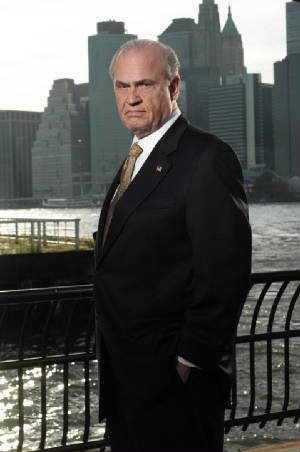
Former U.S. Senator (R-TN)
